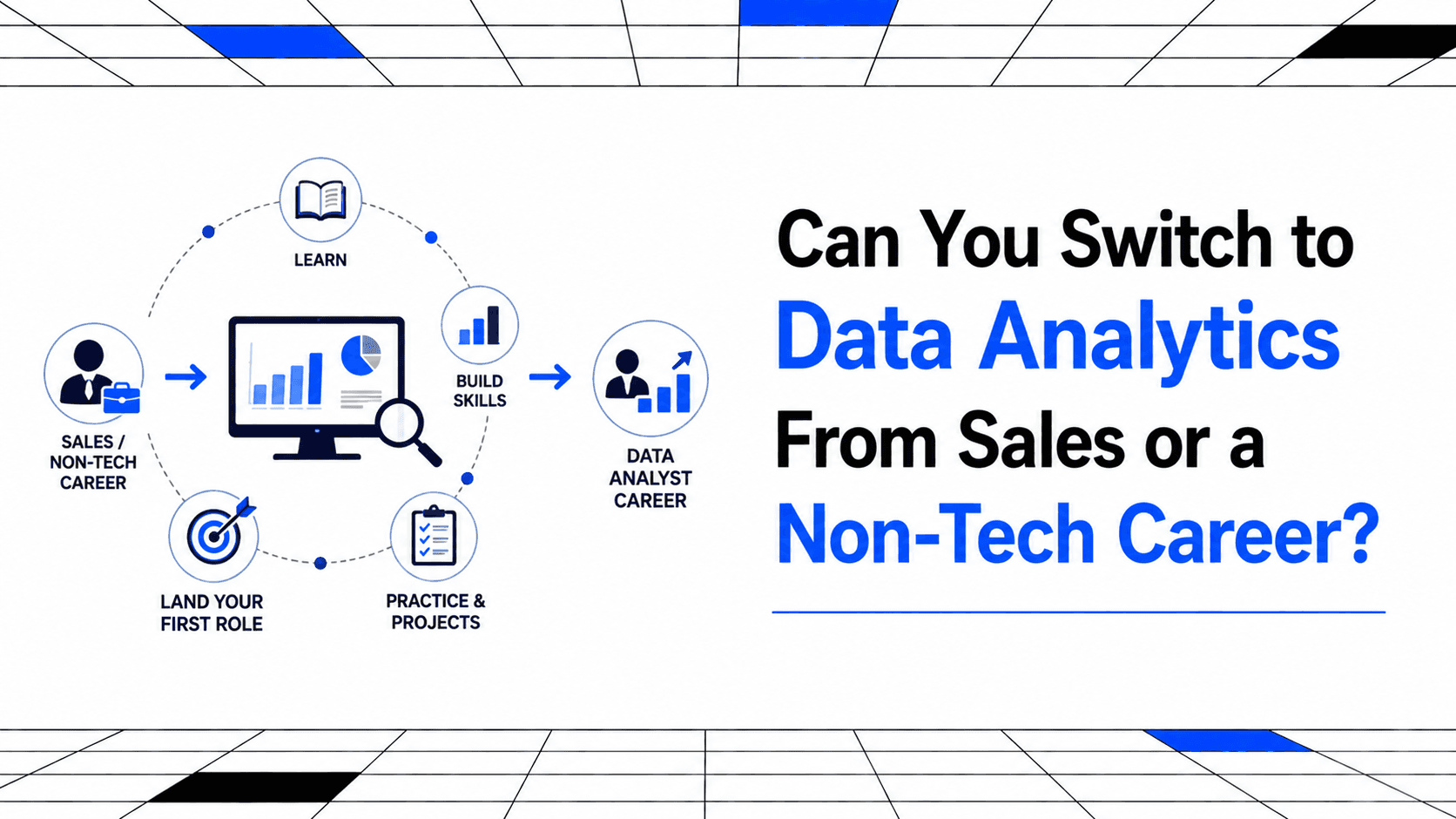
Can You Switch to Data Analytics From Sales or a Non-Tech Career?
Sales and other non-tech careers cover more real ground than they get credit for. The honest gap is narrower and more specific than "start over."
5 Minutes Read
Data Analytics Program — Data Analytics — Next cohort Starts Oct 24 · 35% Discount
Enroll NowSales and other non-tech careers cover more real ground than they get credit for. The honest gap is narrower and more specific than "start over."
Yes, and the more useful question is which specific skills need to be added, not whether a sales background disqualifies you. Sales work is more analytically adjacent than it gets credit for: quota tracking, pipeline forecasting, and conversion rates are real metrics work, and explaining a number to a skeptical stakeholder is a skill a lot of technically trained analysts genuinely struggle with. What is usually missing is narrower than "everything technical": SQL specifically, and analysis that goes beyond what a CRM's built-in dashboard already shows you.
Everything in this article applies just as directly to other non-technical careers, HR, customer support, teaching, operations administration, since they tend to share a similar profile: real communication and domain skill, alongside a similar technical gap. Sales is used as the running example because the metric-driven overlap is the clearest to see.
Ishaan, a field sales executive at an FMCG distribution company in Guwahati, is working through exactly this transition, and his roadmap runs through this article alongside a broader framework.
Stakeholder communication. Explaining a number in terms a decision-maker actually cares about, not just presenting it, is a real, underrated analyst skill, and it is one many technically strong candidates never develop.
Comfort being measured by metrics. Quota attainment, conversion rate, and pipeline velocity are metrics work, even without a technical label attached to it. Occupational data on wholesale sales representative roles lists oral communication, critical thinking, and numerical and arithmetic application among the role's essential skills, alongside customer service and information gathering, which is a broader and more numerically grounded skill set than the role's reputation usually suggests.
CRM and pipeline familiarity. Real, regular exposure to structured records, funnels, and reporting, even without ever writing a query, is a genuine head start over a true cold start.
Resilience under scrutiny. Defending a number to a skeptical audience, a manager questioning a forecast, a client questioning a price, is a practised skill by the time most sales professionals consider this switch, not something to build from nothing.
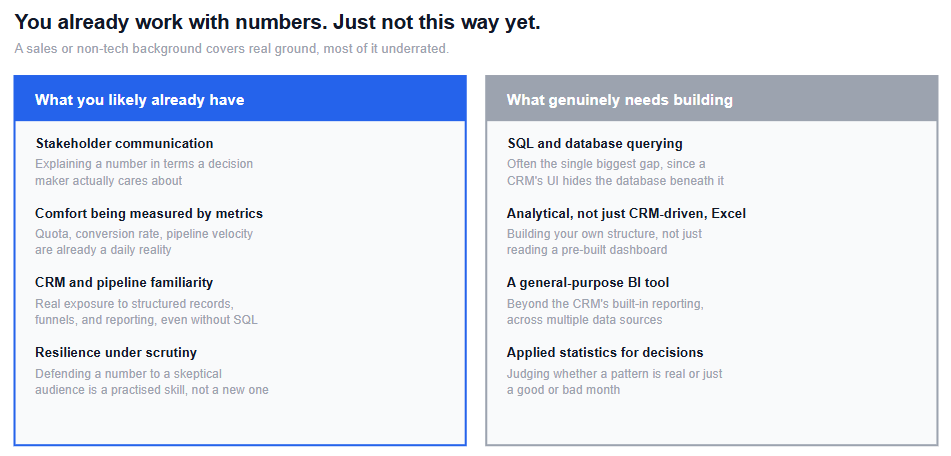
SQL and database querying. This is often one of the biggest technical gaps, though not universal; some sales professionals pick up SQL independently. A CRM's interface is specifically designed to hide the database underneath it, which means years of comfortable CRM use can coexist with zero query-writing experience.
Analytical Excel, not just CRM-generated reports. Reading a pre-built CRM dashboard is a different skill from building your own structure around a messy, unfamiliar dataset, and the gap between the two is usually larger than it looks from the outside.
A general-purpose BI tool. CRM systems have their own reporting built in, but a BI tool like Power BI works across multiple data sources at once, which is closer to what most analyst roles actually require.
Applied statistics for business decisions. Distinguishing a real trend from an unusually good or bad month is a specific, learnable skepticism, not something quota tracking builds automatically.
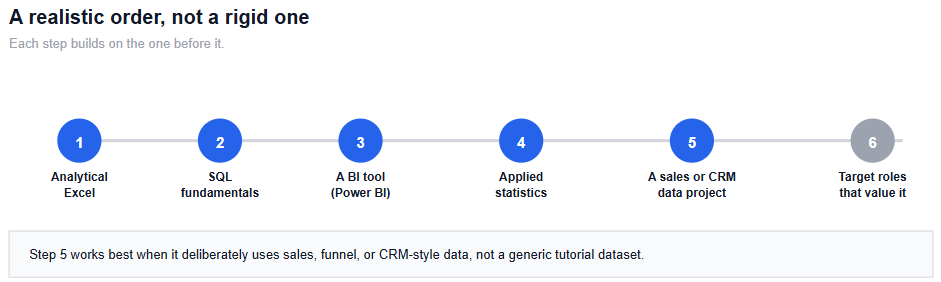
1. Analytical Excel first. This builds past what CRM reporting already provides, rather than starting from zero.
2. SQL fundamentals. The actual new skill, and worth deliberate, sustained practice. The 15 real-world business SQL problems set is built around realistic, ambiguous questions rather than isolated syntax.
3. A BI tool. Power BI is a reasonable default because it is widely used for business reporting and dashboarding, and it is where Excel and SQL skills start turning into something a stakeholder can actually use.
4. Applied statistics. Enough to recognise when a pattern needs more scrutiny before being trusted, not a full academic course.
5. A project grounded in sales or CRM-style data. This is where the existing background becomes a genuine advantage rather than a neutral fact on a resume. A project analysing a public sales or funnel dataset lets pipeline and conversion knowledge do real work, rather than analysing something unrelated to it.
6. Target roles that actually value the combination, covered next, rather than applying only to generic analyst postings where the sales background adds nothing extra.
Role | What it involves | Why a sales background fits |
|---|---|---|
Sales or Revenue Operations Analyst | Analysing pipeline health, forecasting accuracy, and quota attainment across a sales team | Direct overlap with the metrics sales professionals already track daily |
CRM or marketing analyst | Analysing campaign, pipeline, and customer data drawn from CRM and marketing systems | Existing CRM familiarity and funnel literacy |
Business analyst | Combining business context with data-driven recommendations for stakeholders | Career-guidance data on this kind of role describes gathering and analysing operational data, then recommending solutions to stakeholders as core to the work, which maps closely onto sales stakeholder work |
Customer success or retention analyst | Analysing churn, renewal, and account health data | Direct overlap with client relationship and account management experience |
General data analyst | Cross-industry analysis, less tied to a specific business domain | Requires the most new technical skill relative to domain fit |
None of these roles is automatically easier to get than another, but the first three align especially well with the pipeline and stakeholder context a sales background provides, rather than just the new technical skills layered on top of it. It is worth noting that official occupational data for the broader business intelligence analyst category lists a wide range of technical tools, from SQL and Excel to Power BI and Tableau, without naming a specific required degree field or prior career, which is consistent with demonstrated skill mattering more than the specific background on the general data analyst path.
Assuming CRM dashboard fluency is the same as analytical skill. Reading a pre-built report is a different skill from building the analysis behind one.
Underestimating the SQL gap because you are comfortable with numbers generally. Quota fluency and query fluency are genuinely different skills.
Undervaluing stakeholder communication. This is a real, differentiated advantage many technically trained analysts lack, and it is worth naming directly in an application, not treating as unremarkable.
Applying only to generic analyst postings. This wastes the specific advantage a sales or CRM background provides for revenue, RevOps, and customer-facing analyst roles.
Overselling soft skills without building the hard skill foundation. Communication and resilience matter, but they do not substitute for SQL fluency once a live technical interview starts.
Building a portfolio project unrelated to sales or CRM data. This misses the chance to demonstrate the exact combination that makes the background valuable.
Ishaan's daily work already involved tracking a personal pipeline across dozens of distributor accounts in a CRM, forecasting monthly numbers, and explaining shortfalls to his regional manager, work that, once he looked at it closely, already demonstrated real metrics fluency and stakeholder communication. What he did not have was any SQL experience, and his Excel use rarely went beyond exporting a CRM report and lightly formatting it.
He spent the first month on analytical Excel specifically, practising pivot tables and lookups on his own distributor sales data, before starting SQL. By the time he reached SQL, he already understood the underlying business questions well enough to focus entirely on the new syntax. He built his portfolio project around a public retail sales dataset, deliberately choosing something close to his own domain, and used it to practise both SQL and dashboard-building in Power BI.
When he started applying, he specifically targeted sales operations and RevOps analyst postings rather than broad "data analyst" listings, reasoning that his pipeline and forecasting background would matter more there. His first interview's most pointed question was about how he would investigate a sudden drop in regional conversion rate, a question his actual sales experience helped him answer with more genuine business judgement than a purely technical candidate might have shown.
Want a structured way to build the skills behind this roadmap? Gradient Learnings covers SQL, Excel, statistics, and BI tools like Power BI through practical, project-based learning. Explore the programme here: Gradient Learning.
If analytical Excel is the first gap to close, the 25 Excel formulas every data analyst uses list is a reasonable benchmark for what that should actually include.
Once Excel feels solid, your first 10 SQL queries is a reasonable place to start the genuinely new part of this roadmap.
And since stakeholder communication is already a strength worth proving in an interview, 50 data analyst interview questions is a fair way to test whether your technical preparation holds up alongside it.
Quiz
Question 1 of 15
FAQ
FREE COURSES
This course takes you from MySQL fundamentals to job-ready SQL and database skills through 14 structured modules. Learn database design, querying, joins, aggregation, constraints, indexing, CTEs, views, stored procedures, triggers, and transactions with practical examples and exercises. Build four complete portfolio projects covering e-commerce, library management, blogging, and sales analytics. Finish with interview preparation, career guidance, project ideas, and current compensation insights.
This course takes you from Power BI fundamentals to job-ready data analytics skills through seven structured modules. Learn data connections, Power Query, relational modeling, DAX, time intelligence, and interactive dashboard design with hands-on examples. Build six portfolio projects across sales, retail, marketing, finance, and enterprise analytics. Finish with interview preparation, career guidance, project ideas, and current compensation insights.
Learn to design data models that power accurate, fast, and trusted analytics. Starting from grain, keys, and relationships, you will build star schemas, track history with slowly changing dimensions, and implement tested dbt projects on cloud warehouses. The course ends with two hands-on portfolio projects. Basic SQL is all you need to start.