Data Modeling for Analytics

Learn to design data models that power accurate, fast, and trusted analytics. Starting from grain, keys, and relationships, you will build star schemas, track history with slowly changing dimensions, and implement tested dbt projects on cloud warehouses. The course ends with two hands-on portfolio projects. Basic SQL is all you need to start.

author

Rutvik Acharya

Principal Data Scientist

Atlassian

Loading modules...

What You'll Learn

Design star schemas with the right grain, keys, and measures

Track history with slowly changing dimensions and conformed dimensions

Build tested, documented dbt models, including incremental loads and snapshots

Optimize cloud warehouse performance and define consistent business metrics

Who Should Attend

Data analysts who want to build models instead of just querying them

Analytics engineers and BI developers designing warehouse layers

Data engineers moving into analytics modeling

Anyone with basic SQL who wants to produce numbers people can trust

CERTIFICATION

Certificate of Completion
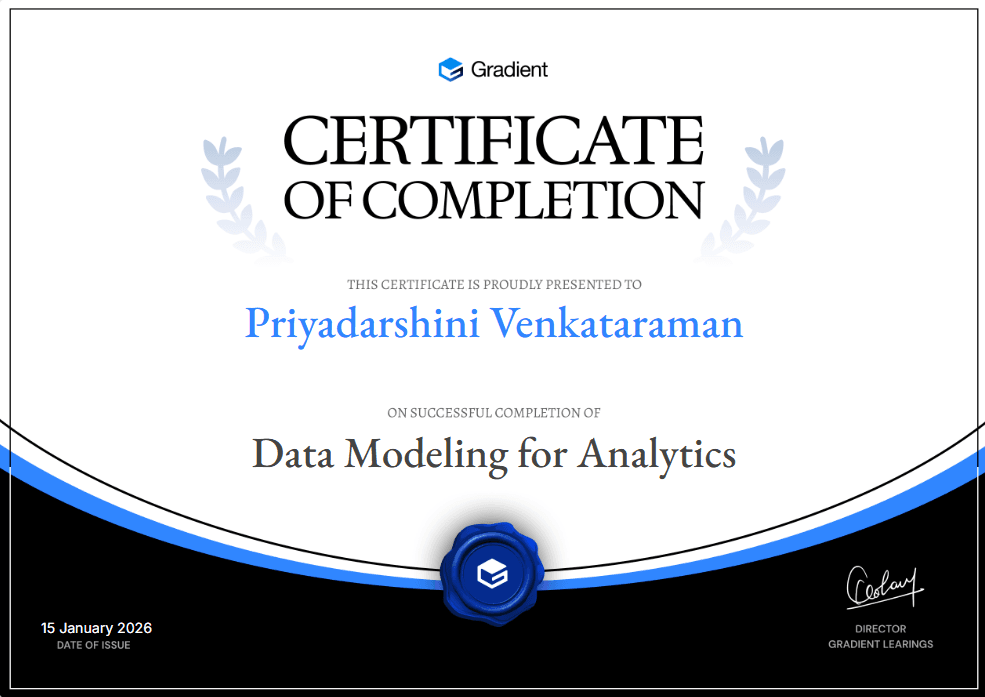
Certificate of Participation
Course
9 Modules
20 Hours
50 Lessons
50 Challenges
Language: English

FAQ

FREQUENTLY ASKED QUESTIONS

You should know basic SQL, specifically SELECT, JOIN, and GROUP BY. No prior data modeling experience is needed. The course starts with the fundamentals and builds up to production-level work.
It is designed for data analysts, analytics engineers, BI developers, and data engineers who want to build models that people can trust, instead of only writing queries against tables someone else designed.
You will be able to design star schemas with the right grain, keys, and measures, preserve history with slowly changing dimensions, and build tested, documented dbt projects. You will also be able to tune performance on cloud warehouses and define consistent business metrics.
The course has nine modules. The first eight cover the fundamentals through advanced topics, and each lesson includes practical examples, common mistakes, best practices, a practice exercise with a worked solution, and interview questions. The ninth module contains two end-to-end portfolio projects.
Modules 1 to 8 follow one fictional outdoor-gear retailer, Harborline Outfitters, so the examples build on each other as the model grows more complex. The two portfolio projects use new fictional companies so you can apply the material to a fresh situation.
The lessons use ANSI-style SQL, with notes where Snowflake, BigQuery, or Postgres differ, and the modern data stack lessons use dbt Core. The portfolio projects are written in the DuckDB dialect so you can run them for free on your own computer.
The first project builds a subscription analytics warehouse for a SaaS company called Pulsewave, covering MRR, churn, and cohort retention. The second builds an omnichannel inventory and sales mart for a grocery chain called Fieldstone Market, covering stock-outs, promotions, and online fulfillment. Each project has eight business questions with fully worked solutions.
Yes. Each project comes with downloadable source data, models, tests, and the SQL answers, plus a script that builds everything in DuckDB on your laptop and reproduces every number in the solutions.
Yes. Module 6 covers layered ELT architecture, dbt models, sources, and ref(), materializations, incremental fact tables, snapshots for tracking history, data tests, unit tests, contracts, and documentation. The lessons note that some dbt configuration syntax changes between versions, so you should check the documentation for the version you use.
No. The course focuses on the modeling skills themselves, and the final module is the two portfolio projects, which you can use to demonstrate your skills.
Scroll Up
GET FREE CAREER COUNSELING