MySQL for Data Analysts

This course takes you from MySQL fundamentals to job-ready SQL and database skills through 14 structured modules. Learn database design, querying, joins, aggregation, constraints, indexing, CTEs, views, stored procedures, triggers, and transactions with practical examples and exercises. Build four complete portfolio projects covering e-commerce, library management, blogging, and sales analytics. Finish with interview preparation, career guidance, project ideas, and current compensation insights.

author

Rutvik Acharya

Principal Data Scientist

Atlassian

Loading modules...

What You'll Learn

Design relational databases using proper data types, constraints, and keys

Query and filter data confidently with SELECT, WHERE, JOIN, and GROUP BY

Write advanced SQL using subqueries, CTEs, views, and window functions

Complete four full portfolio projects — from an e-commerce system to a sales analytics schema

Who Should Attend

Aspiring Data Analysts who need strong SQL fundamentals

Beginners with no prior database or SQL experience

Developers looking to deepen their MySQL and database design skills

Anyone preparing for a SQL Developer, DBA, or Data Analyst interview

CERTIFICATION

Certificate of Completion
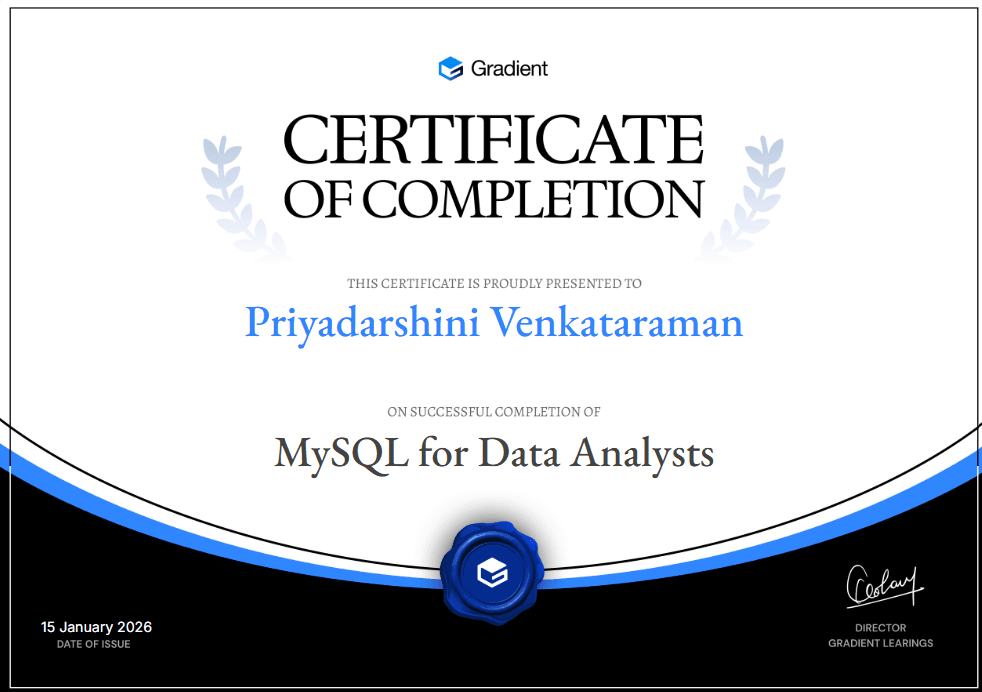
Certificate of Participation
Course
13 Modules
21 Hours
52 Lessons
52 Challenges
Language: English

FAQ

FREQUENTLY ASKED QUESTIONS

No. The course starts with what a relational database is and covers installation, basic queries, and table design before progressing to joins, indexing, and stored procedures.
You'll need MySQL installed locally or access to a MySQL server, along with a client such as MySQL Workbench or the command-line client. Both are free, and setup is covered in Module 1.
Both. Alongside querying, filtering, and aggregation, the course covers table design, data types, constraints, and relationships, giving you the skills to design a database from scratch.
The course goes well beyond core querying, covering subqueries, CTEs, views, window functions, stored procedures, triggers, transactions, indexing and performance tuning, partitioning, and SQL injection security.
The course includes four full portfolio projects: an e-commerce order system, a library management database, a blog platform schema, and a sales analytics reporting system. Each includes schema design, sample data, and worked query solutions.
Scroll Up
GET FREE CAREER COUNSELING