How to Choose Your First Data Analytics Specialization: Marketing, Finance, Product or Operations
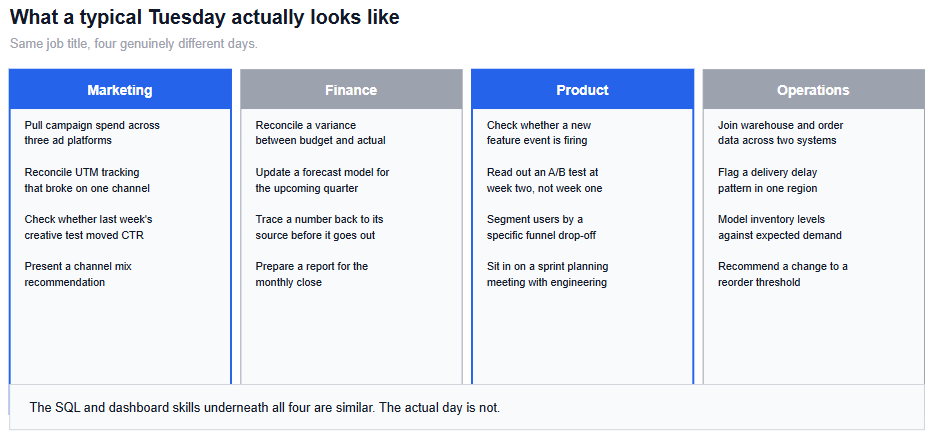
Marketing analytics, finance analytics, product analytics, and operations analytics all use the same core tools. SQL, Excel, and a BI tool look the same regardless of which business function you end up working in. The work itself does not. A marketing analyst spends real time reconciling data across ad platforms that were never designed to agree with each other. A finance analyst spends real time making sure a number reconciles exactly before it goes into a report someone will be held accountable for. A product analyst spends real time checking whether an event was even logged before trying to analyse it. An operations analyst spends real time joining data across systems that were built years apart for different purposes. Same core toolkit, four genuinely different jobs.
Picking a first specialization is not permanent, and this article will say that more than once because beginners tend to treat it as a bigger decision than it is. It does, however, meaningfully change what to practise next and which portfolio project to build. Farhan, an entry-level analyst at a consumer electronics retail company in Bhopal, is deciding between marketing and operations, the two functions his company actually has open roles in, and his reasoning runs through this article alongside the comparison.
What actually differs across the four
Marketing analytics
What it involves: campaign performance, channel attribution, funnel and conversion analysis, cohort and retention tracking, and testing creative or messaging changes against real engagement.
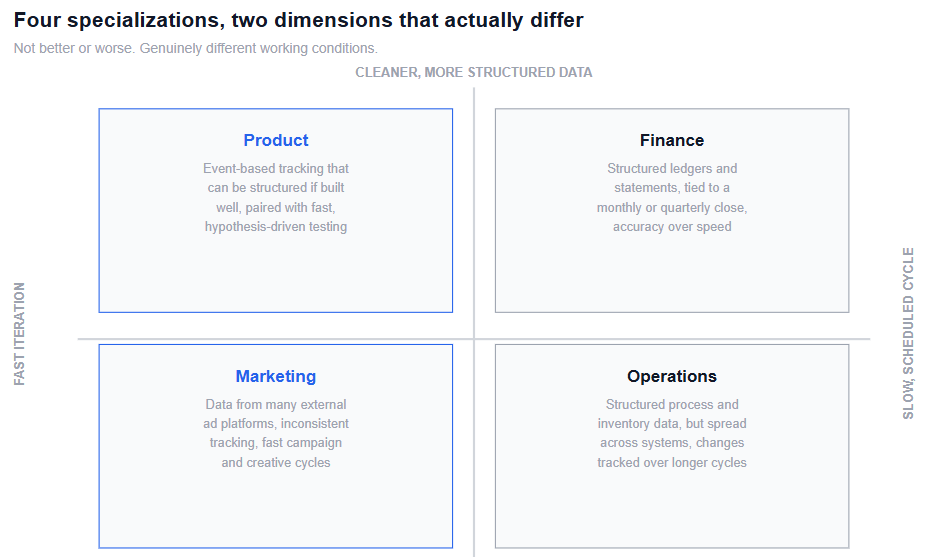
The skill emphasis: comfort with messy, less standardised data is the real differentiator here. Data arrives from multiple ad platforms that track things slightly differently, tracking links break, and reconciling numbers across sources is a genuine, recurring skill rather than an occasional annoyance. Occupational data on market research and marketing-adjacent analyst roles lists critical thinking, information gathering, creativity, and attention to detail among the top essential skills, which reflects how much of the work involves making sense of imperfect external data, not just analysing clean internal numbers.
The honest caveat: the pace is fast, and marketing data is often less standardised because it comes from multiple external platforms, which some people find energising and others find exhausting.
Good fit if: you like campaigns, experimentation, and working closely with creative or growth teams, and imperfect data does not bother you much.
Finance analytics
What it involves: budgeting, forecasting, variance analysis, and recurring reporting tied to a monthly or quarterly close.
The skill emphasis: precision and traceability matter more here than almost anywhere else in analytics. A number that is close is not the same as a number that is correct, and being able to trace a figure back to its source before it goes into a report matters as much as the analysis itself. Occupational data on financial analyst roles lists critical thinking, numerical and arithmetic application, and attention to detail among the role's top essential skills, consistent with how much of the work depends on getting a number exactly right rather than approximately right. Excel remains genuinely central to this work far more than in most other specializations.
The honest caveat: the pace is often slower and more scheduled, tied to reporting calendars rather than continuous experimentation, which suits some people and frustrates others who prefer faster iteration.
Good fit if: you like precision, structure, and working within accounting or financial frameworks, particularly if that overlaps with an existing commerce or finance background.
Product analytics
What it involves: feature usage, funnel analysis, running and reading experiments, user segmentation, and defining the metrics a product team actually tracks.
The skill emphasis: instrumentation is the real differentiator. A metric cannot be measured if the underlying event was never logged, and this is not a hypothetical concern; official technical documentation for a widely used analytics platform is explicit that, beyond a small set of automatically captured events, an application has to explicitly log anything else it wants to track. Product analysts spend real time working with engineering to make sure the right events exist before they can be analysed at all.
The honest caveat: this specialization depends heavily on good instrumentation already existing, or being willing to advocate for building it, which can be a genuinely frustrating bottleneck at a company with weak tracking.
Good fit if: you are curious about user behaviour, enjoy hypothesis-driven experimentation, and want to work closely with product and engineering teams.
Operations analytics
What it involves: process efficiency, inventory and supply chain analysis, delivery and logistics performance, and capacity planning.
The skill emphasis: this work tends to require pulling data together across more systems than the other three specializations, warehouse management, order systems, and logistics platforms that were rarely designed to talk to each other cleanly. Occupational data on operations-research-adjacent roles describes applying mathematical modeling and optimisation methods to logistics, supply chain, and resource allocation problems, which captures the more systems-level, process-oriented thinking this specialization rewards compared to the other three.
The honest caveat: this specialization gets less attention in general analytics content than marketing or product, despite being genuinely substantial, particularly in manufacturing, logistics, and retail-heavy economies.
Good fit if: you like process, systems thinking, and efficiency problems, and you do not need the work to be publicly visible to find it satisfying.
How to actually choose
Three questions matter more than which specialization sounds most impressive.
Which pace and data condition genuinely suits you? Fast and messy, or slower and precise, is a real, honest preference, not a strategic calculation, and fighting against your own preference tends to show up as burnout rather than growth.
Does an existing background overlap with one of the four? A commerce or finance background maps naturally onto finance analytics. An operations, logistics, or engineering background maps naturally onto operations analytics. This is not a requirement, but it is a real head start worth using.
Which one can you actually test? Building a small project grounded in real marketing, finance, product, or operations data, using a public dataset if nothing else is available, tells you more in a weekend than reading about the specialization ever will.
Common mistakes when choosing a first specialization
Choosing based on prestige rather than fit. Product analytics gets talked about the most in general tech content, which is a poor reason to choose it over a specialization that actually matches how you like to work.
Treating the choice as permanent. Analysts can change specializations over a career, and the first choice should be treated as a starting point rather than a permanent decision.
Ignoring an existing background that already overlaps with one domain. This is free head start that gets wasted when the choice is made from a blank slate instead.
Not testing a specialization before committing. A small project in the actual domain reveals more about fit than any amount of reading.
Underestimating how different the honest caveats actually are. Assuming marketing analytics will be as precision-focused as finance, or that finance will move as fast as product, leads to real frustration a few months in.
Picking the specialization with the least perceived competition rather than genuine interest. A specialization chosen purely for lower competition rarely sustains motivation once the honest, harder parts of the work show up.
How Farhan decided
Farhan's company runs a fairly large e-commerce operation alongside a substantial physical inventory and logistics function, and both teams had open analyst roles he could reasonably apply for internally.
Rather than guessing, he spent two weekends building a small project in each domain using data he could access. For marketing, he pulled together spend and conversion data across the company's two main ad platforms and tried to reconcile a discrepancy between what each platform reported as conversions, discovering along the way that this reconciliation work was itself most of the job, not an occasional side task. For operations, he joined warehouse dispatch data with delivery tracking data to identify which regional routes had the highest delay rates, work that required more systems-joining and less fast iteration than the marketing project had.
The operations project was the one he found himself returning to on his own time, not because it was easier, but because the process-level puzzle of it held his attention longer. He applied for the operations analyst opening specifically, and used the delivery-delay project directly in his interview, walking through exactly the kind of systems-joining and process reasoning the actual role called for daily.
Want a structured way to build the skills behind any of these specializations? Gradient Learnings covers SQL, Excel, statistics, BI tools, and product analytics through practical, project-based learning. Explore the programme here:Gradient learnings.
Where to go from here
If product analytics is the direction that appeals most, how AI is changing the data analyst role and A/B testing for data analysts cover two skills that specialization leans on heavily.
If the data-reconciliation side of marketing or operations analytics sounds like the right kind of challenge, 15 real-world business SQL problems is a reasonable way to practise the multi-source joining both specializations require.
And regardless of which specialization you are leaning toward, 20 data analytics project ideas for beginners is a fair starting point for the small test project this article recommends building before committing.