How AI Is Changing the Data Analyst Role, and What Stays Human
A task-by-task audit of what AI now handles, what it assists with, and what still needs a human in the loop
6 Minutes Read
A task-by-task audit of what AI now handles, what it assists with, and what still needs a human in the loop
Most writing on this topic sits in one of two camps. One says AI is about to make the data analyst role obsolete. The other says AI changes nothing that matters and analysts should carry on exactly as before. Neither is an honest description of what's actually happening inside real analytics teams right now.
The more useful question isn't "will AI replace analysts." It's "which specific tasks inside this job have actually changed, and which haven't." Those are different questions with different, checkable answers, and answering them task by task is far more useful for planning a career than either the panic or the hype version of this story. That's the approach this guide takes, in the same register as the practical piece on this topic linked at the end: neither camp, just an honest look at where the line currently sits.
McKinsey's research on generative AI's automation potential found that current AI technology has the theoretical potential to automate work activities that absorb 60 to 70 percent of employees' time today, a sharp jump from earlier estimates, driven mainly by AI's improved ability to handle natural language. That figure describes what's technically possible to automate, not how much work has actually been automated in practice, and the gap between those two things matters. But the headline number also hides something important: the automation potential is wildly uneven across task types, not a flat percentage applied evenly to every part of a job.
McKinsey's own analysis of software development tasks specifically shows this unevenness clearly: code documentation saw a 45 to 50 percent reduction in completion time with AI assistance, code generation 35 to 45 percent, code refactoring 20 to 30 percent, and high-complexity tasks less than 10 percent. Those figures come from software engineering work, not from data analyst tasks specifically, and they're used here as an analogy rather than direct evidence about this role. But the pattern they illustrate, mechanical and well-specified tasks seeing large gains, judgment-heavy and ambiguous tasks seeing very little, is the same pattern that shows up inside data analyst work, and it's the organising idea behind the audit below.
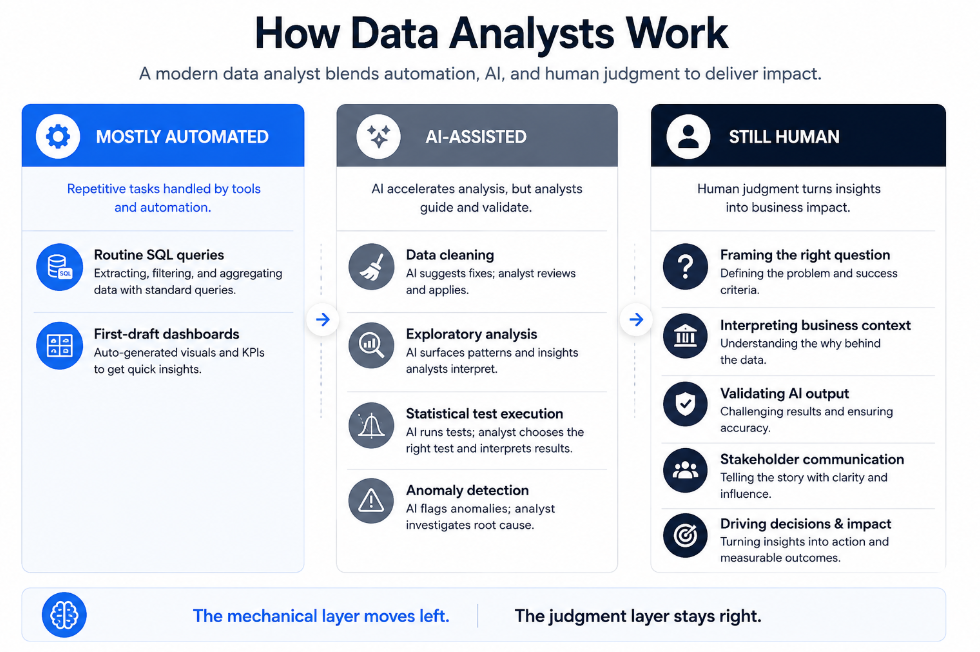
Rather than asking whether AI is "coming for" the analyst role in the abstract, here's what's actually true for twelve specific tasks that make up the job.
Task | Where it sits | Why |
|---|---|---|
Writing a routine SQL query against a known schema | AI-led / highly automatable | Well-specified, syntax-heavy, and the schema is known. This is exactly the kind of mechanical task current tools handle reliably. |
First-draft dashboards and standard charts | AI-led / highly automatable | Chart type and layout for a familiar report type is a repeatable pattern AI reproduces quickly and consistently. |
Cleaning and reformatting messy data | AI-assisted | AI catches obvious issues fast, but deciding what a missing value actually means for this business still needs a person. |
Exploratory analysis on a brand-new dataset | AI-assisted | A first-pass profile of structure and quality issues is a genuine time-saver; deciding what's actually interesting in it isn't. |
Complex, business-logic-heavy SQL | AI-assisted | A good first draft, but the business rules, which accounts to exclude, how a fiscal quarter is defined, usually live outside what the AI can see. |
Statistical test selection and execution | AI-assisted | The mechanics run fast; whether the sample, the assumptions, and the framing are actually valid for this question is still a judgment call. |
Anomaly and pattern detection in a large dataset | AI-assisted | Genuinely useful for surfacing candidates worth a closer look; deciding which ones matter is still manual. |
Validating that an AI-generated result is actually correct | Human judgment remains central | This is close to a new task category entirely, and it's covered in more depth below. |
Deciding which question is actually worth asking | Human judgment remains central | AI can answer the question it is given; deciding whether that was the right question to ask is a different skill. |
Interpreting a number within this specific business's context | Human judgment remains central | The same statistic means something different at a three-person startup than at a 3,000-person enterprise, and AI has no access to that context unless it's spelled out in full. |
Communicating a finding and a recommendation to a stakeholder | Human judgment remains central | Reading the room, knowing what a specific VP actually needs to hear, and standing behind a recommendation in a meeting isn't a text-generation problem. |
Navigating an ambiguous or politically sensitive request | Human judgment remains central | Two departments disagreeing about whose numbers are right is a relationship problem wearing a data costume. |
This task has become much more important with the rise of generative AI, and it is worth treating separately from simply writing SQL, even though it looks similar on the surface.
Recent research analysing errors in AI-generated SQL found that schema-related mistakes, referencing the wrong table or column, account for over 80% of execution failures, while semantic errors, where the query runs successfully but misinterprets the actual business question, made up roughly 36.1% of errors in one widely used benchmark. The paper also cites the NL2SQL-Bugs benchmark, where state-of-the-art LLMs achieved 75.16% accuracy at detecting semantic errors, meaning a meaningful share of these errors go uncaught even by the models best equipped to find them.
That second category, a query that runs without error and returns a plausible-looking number that's actually wrong, is the dangerous one. A broken query announces itself. A query that silently excludes test accounts, or defines "active user" differently than the dashboard next to it does, looks completely normal until someone builds a decision on top of it. Catching that kind of error requires knowing what the number should roughly look like, which is exactly the business context an AI tool doesn't have unless an analyst supplies it. This makes a human validation step especially important when AI-generated analysis is being used to support business decisions.
If you're early in this career, the practical read on all of this is straightforward: the mechanical layer of the job is genuinely getting faster to produce, and the judgment layer is where the actual differentiation now sits.
The World Economic Forum's Future of Jobs Report identifies analytical thinking as the single most sought-after core skill among employers, with seven in ten calling it essential, and that finding predates the current wave of AI tooling rather than reacting to it, which is itself informative: the thing employers have always wanted most from an analyst was never "can write correct SQL syntax." It was always the reasoning underneath it. AI has just made that distinction harder to hide behind.
This doesn't mean the technical skills stop mattering. You can't evaluate whether an AI-generated query is right if you don't understand SQL well enough to read it yourself, and the SQL, Excel, and statistics fundamentals covered elsewhere in this series, alongside the Python skills that increasingly sit next to them, are still exactly what makes the validation step possible in the first place. The read isn't "skip the fundamentals and go straight to prompting." It's "learn the fundamentals well enough that you're the one catching the AI's mistakes, not the one making them because you skipped the step where you'd have noticed."
"AI writes better SQL than I ever will, so there's no point learning it deeply." You need to understand SQL well enough to read and catch a wrong join or a misapplied filter in someone else's query or an AI-generated query. That's a reading skill, and it doesn't develop from prompting alone.
"This wave is different, and the job is genuinely going away." The U.S. Bureau of Labor Statistics projects Data Scientist employment to grow 34% from 2024 to 2034, much faster than the 3% average for all occupations. That does not directly measure Data Analyst employment specifically, since it's a related but distinct occupational category, but it is evidence against treating AI as something that automatically eliminates analytical work. Worth noting too that O*NET's Business Intelligence Analyst profile lists Data Analyst among its alternate job titles, and identifies analysing data, critical thinking, interpreting information, and communication as core work activities and skills, the same judgment-heavy list this guide keeps returning to.
"If I just learn to prompt well, the underlying skills matter less." Prompting is a small, fast-to-learn skill sitting on top of the judgment this whole guide is about. It doesn't substitute for knowing whether an output is actually correct.
"Validating AI output is basically the same as double-checking a coworker's spreadsheet." It's closer, but the failure mode is different: a coworker who doesn't know an answer usually says so. A model asked to generate SQL against a schema it doesn't fully understand tends to produce something plausible-looking regardless, which is precisely why the check can't be skipped.
This guide covers the shape of the change. For the practical side, how to actually use AI tools inside SQL, Excel, and Python workflows without letting them make silent mistakes, the AI and GenAI tools changing analytics workflows piece goes deeper into specific use cases.
The strongest defence against the validation problem described above is simply knowing the fundamentals well enough to catch a mistake when you see one. If SQL is the area you'd want to shore up first, the SQL for Data Analysts guide is the place to start, and the statistics guide covers the same judgment layer for anything involving a test, a sample, or a claim about significance.
Quiz
Question 1 of 15
FAQ