Product Analytics for Data Analysts

A 12-module, hands-on course that teaches product analytics using one real, consistent dataset from start to finish, SQL, funnels, retention, A/B testing, segmentation, churn modeling, and stakeholder communication. Every number is computed and verified, not invented. Ends with two full portfolio projects you can show off.

author

Rutvik Acharya

Principal Data Scientist

Atlassian

Loading modules...

What You'll Learn

Write production-grade SQL for funnels, retention, cohorts, and experiment analysis

Design and analyze A/B tests, from sample sizing to guardrails to honest interpretation

Build real Python models (k-means clustering, logistic regression) and evaluate them rigorously

Turn findings into dashboards, memos, and recommendations stakeholders actually trust

Who Should Attend

Aspiring data analysts who want real practice, not toy examples

Analysts who know SQL basics and want product-specific skillsc

PMs or engineers who need to read and challenge analytics work

Anyone building a portfolio for a data analyst role

CERTIFICATION

Certificate of Completion
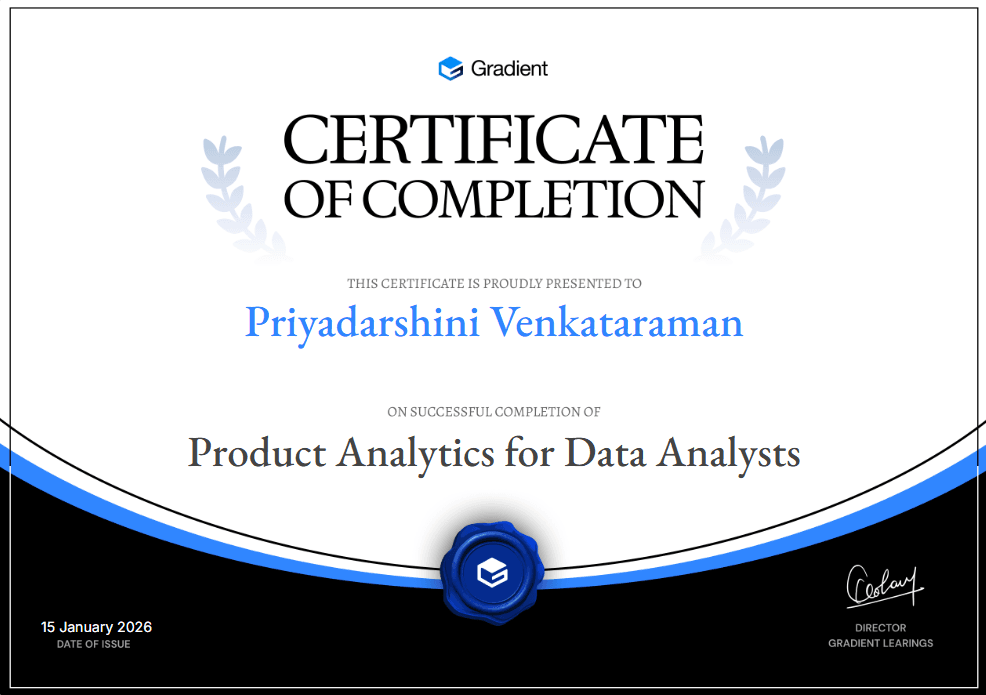
Certificate of Participation
Course
12 Modules
40+ Hours
64 Lessons
64 Challenges
Language: English

FAQ

FREQUENTLY ASKED QUESTIONS

No prior business intelligence experience is needed. The course starts with what BI is and builds up from there. Basic familiarity with SQL helps in the calculation modules, which begin with aggregation and grouping.
It is designed for aspiring and junior data analysts, BI developers, and business analysts who report on performance. It also suits anyone who wants to turn data into clear decisions.
You will learn to define and design KPIs, calculate them with SQL, and compare them over time. You will also learn to diagnose changes, design dashboards, check data quality, run experiments, and present your findings clearly.
Yes. This is a free course, and all 13 modules are included.
The course has 13 modules and 94 lessons. Each lesson includes worked examples, a practice exercise, interview questions, and key takeaways, and every module ends with a summary and an answer key.
Reading the whole course takes roughly 20 hours. Add time for the practice exercises, which depends on how much you work through on your own.
The SQL examples are written for PostgreSQL, so having a PostgreSQL database to practice on is helpful. Some later lessons, such as experiments and forecasting, use short Python scripts with numpy, pandas, and scipy.
No. The examples use invented data from a fictional retailer called Meridian Goods, and the capstone uses a fictional coffee subscription business. Because the data is made up, you can safely share your practice work, and the lessons can show how each method behaves.
Every lesson ends with interview questions that describe what a strong answer looks for, so you can practice explaining the ideas out loud. The course does not promise a job, but it gives you plenty of material to rehearse with.
The final module applies the methods from the earlier modules to one new project. You choose and scope a question, build and check the data, analyze it, and finish with a decision and a plan for a follow-up test.
Scroll Up
GET FREE CAREER COUNSELING