Data Analytics Course vs Certification: What's the Difference?
"Course" and "certification" get used almost interchangeably in data analytics marketing, and that is not an accident. A provider selling a twelve-week programme benefits from the word "certified" showing up next to it, even when what you actually receive at the end is a certificate of completion from that same provider, not a credential from an independent examining body. The two words describe genuinely different things, and the difference matters more than it looks like it should when you are deciding where to spend the next few months.
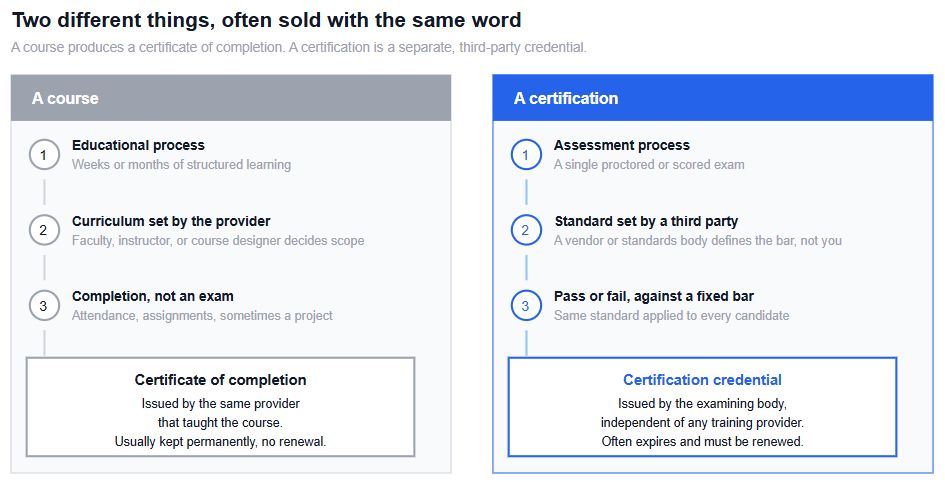
A course is an educational process. You show up, work through a curriculum somebody else designed, and finish with a certificate that says you completed it. A certification is an assessment process. You take an exam set by a third party against a fixed standard, and you either meet that standard or you do not. One builds skills. The other verifies them. Most people benefit from both, in that order, but almost nobody needs to start with the second one.
Aisha, a supply chain analyst at a Bengaluru fashion e-commerce company, runs into this exact decision later in this article. She already does manual Excel reporting daily and is trying to work out whether she needs a certification to prove one specific skill to her manager, or a broader course to build the skills she does not have yet. Her answer will not be everyone's answer. The distinction she is working through will be.
What a course actually is
A course is a structured programme, typically running weeks to months, built around a curriculum that the provider designs. It can be run by a university, a private training company, or delivered as a free set of tutorials you assemble yourself. What makes it a course rather than a certification is the process: you learn material over time, complete assignments or projects, and finish by demonstrating that you completed the programme, not by passing a standardised exam against an external benchmark.
The credential you receive at the end, when you receive one, is a certificate of completion. This is issued by the same organisation that taught you, based on criteria that organisation set itself. Academic institutions formalise this concept explicitly: the University of Florida, for instance, defines an undergraduate certificate as a specific bundle of coursework, requiring a minimum of nine credit hours of university coursework completed with a passing grade, awarded and recorded by the university itself. That is a course credential in its cleanest form: defined by the teaching institution, awarded by the teaching institution, no external examiner involved.
None of this makes a course credential worthless. It is evidence that you spent real time on a defined curriculum, which is exactly why the curriculum quality checks that matter for any course, named projects, real datasets, deliverables you can point to, matter far more than the certificate itself.
What a certification actually is
A certification is a credential awarded by an independent third party, a software vendor or a recognised professional or standards body, based on passing a defined assessment. The organisation issuing the certification is not the one that necessarily taught you. It set a bar, and you either cleared it or you did not, on a specific date, under specific conditions.
A concrete, real example makes this easier to see than an abstract definition does. Microsoft's Power BI Data Analyst Associate certification requires passing a single proctored exam, PL-300, assessed against four specific skill areas: preparing data, modelling data, visualising and analysing data, and managing and securing Power BI. The exam runs 100 minutes, is proctored rather than self-graded, and the certification itself expires and must be renewed roughly every 12 months by passing a further assessment. Nothing about that structure resembles a course. There is no curriculum you sit through as part of the certification itself, only a standard you either meet or do not, on the day you sit the exam.
That structure, third-party standard, proctored assessment, and renewal requirement, is what separates a genuine certification from a course that has borrowed the word for marketing purposes. A twelve-week programme that calls its own completion certificate a "certification" is describing a course credential using certification language, and the two are not interchangeable no matter which word appears on the badge.
Course vs certification: the comparison
What to compare | Course | Certification |
|---|
Purpose | Build skills across a curriculum, often several related tools and concepts | Verify mastery of a specific, narrowly defined skill set |
Format | Structured learning over weeks or months, live or self-paced | A single assessment, usually timed and proctored |
Who sets the standard | The training provider or institution | An independent vendor or standards body |
Who issues the credential | The same organisation that taught the material | The examining body, independent of any specific training provider |
Assessment method | Assignments, projects, attendance, sometimes a final project | Pass or fail against a fixed, standardised bar |
Renewal | Usually none; the certificate is permanent | Often required; many vendor certifications expire and must be renewed periodically |
Typical time investment | Weeks to several months | Hours of study plus a single exam sitting, once the underlying skill exists |
Best for | Building breadth across multiple connected skills from a lower starting point | Proving mastery of a skill you already have, for a specific requirement |
What it signals to an employer | You completed a structured learning process | You met a fixed, externally verified standard on a specific date |
Neither format is inherently better. A course with no real deliverables and a certification chasing a framework the reader has never heard of are both weak signals for different reasons, and the comparison above is about what each format is actually built to do, not which one wins.
When a certification makes more sense
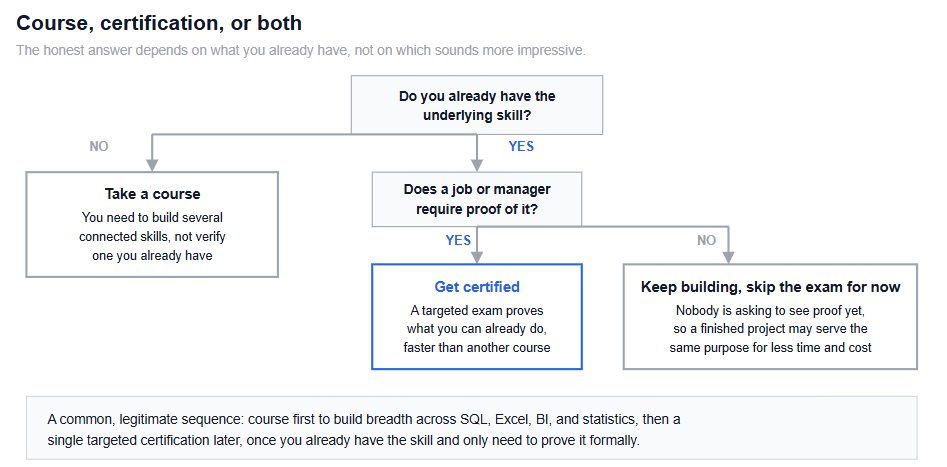
A certification earns its cost and time when the underlying skill already exists and what is missing is proof, not competence. Three situations come up repeatedly:
A job posting or internal role specifically names a certification. Some organisations, particularly larger enterprises standardised on a specific platform, list a named certification as a requirement or strong preference. When that is the actual barrier, a course covering the same ground does not clear it.
You already know the tool and need a fast, credible way to prove it. Someone who has used Power BI daily for two years but has never formalised that knowledge is a strong candidate for a certification exam, not a beginner course that would re-teach material they already know.
You want a renewable, externally verifiable signal on your resume. Because certifications are issued and tracked by the examining body rather than a training provider, they are independently checkable in a way a course completion certificate usually is not.
When a course makes more sense
A course earns its cost and time when the gap is in the underlying skill itself, not in proving a skill you already have.
You are building multiple connected skills from a lower starting point. SQL, spreadsheet analysis, a BI tool, and basic statistics are usually learned better together than in isolation, since real analyst work moves between them constantly.
You are switching domains or starting from close to zero. A certification exam assumes the underlying competence already exists. If it does not, studying only for the exam produces someone who can pass a specific test without the surrounding judgment a real analyst role requires.
You need a finished project, not just a score. Most certification exams do not produce a portfolio piece. A course built around named, real deliverables gives you something to walk an interviewer through, which a pass/fail exam result does not.
Can you do both, and does order matter
Yes, and the order most people get right without realising it is course first, certification second.
A course builds the underlying skill across several connected areas. A certification, taken afterward, verifies one specific piece of that skill against an external standard, on a resume line that renews and stays current in a way a course completion certificate does not. Taken in the reverse order, a certification pursued before the underlying skill exists tends to produce someone who can pass a specific exam without the broader competence the exam assumes, which shows up quickly once they are actually doing the job.
This is not a rule that applies to everyone. Someone who already has years of hands-on tool experience and simply never formalised it can reasonably skip straight to a certification. The sequencing question is really the same diagnostic question that runs through the rest of this article: are you building a skill, or proving one you already have.
Verifying legitimacy, for both formats
The same scrutiny applies whether the credential in question is a course certificate or a professional certification, and it is worth running before you commit time or money to either.
Treat marketing claims about outcomes the same way regardless of the label on the credential. India's consumer protection regulator has taken this seriously enough to issue formal guidance. The Central Consumer Protection Authority's 2024 guidelines require coaching and training providers to disclose accurate information about their programmes and prohibit unverified success-rate and guarantee claims, and nothing in that guidance distinguishes between a provider calling its offering a course or a certification. A number with no source or sample size is a marketing claim either way.
If a certification claims alignment to a recognised skill framework, check that specifically. India's National Skills Qualification Framework, overseen by the National Council for Vocational Education and Training, grades and recognises skill-based qualifications through a formal review process. Recent NSQC proceedings confirm this is an active, ongoing review body, which means an "NSQF-aligned" certification claim is either genuinely on record or it is borrowing the credibility of a framework it was never actually reviewed against.
For a genuine third-party certification, verify who is actually issuing it. A real certification names its examining body clearly, has a defined exam format, and typically offers some way to independently verify a specific credential, the way Microsoft's own certification pages let you check exam structure and renewal requirements directly rather than taking a provider's description of them on faith.
Common mistakes people make choosing between the two
Assuming "certified" in a course name means an independent body assessed it. Read past the word to what actually issues the credential and how it is assessed.
Pursuing a certification before the underlying skill exists. This usually means cramming for a single exam rather than building competence, and it shows in an interview quickly.
Treating a course completion certificate as equivalent proof to a professional certification. They signal different things to an employer, and conflating them undersells whichever one you actually have.
Choosing a certification because it sounds more impressive, not because a specific requirement calls for it. If nothing you are applying for names it, the time may be better spent on a portfolio project instead.
Ignoring renewal requirements. A certification that lapsed two years ago is weaker evidence than a recent one, and lapsed credentials are worth updating before they become a gap someone asks about.
Skipping the legitimacy check because the provider sounds official. Official-sounding names do not verify recognition. The framework's own governing body does.
How Aisha decided
Aisha's actual gap was narrower than it first looked. She had three years of daily Excel work and had picked up Power BI informally over the past year, building dashboards nobody had asked her to build. What she did not have was SQL, any formal exposure to statistics, or a way to prove any of it to a hiring manager outside her current team.
She ruled out jumping straight to a Power BI certification first, even though it was tempting since it felt like the fastest visible win. The underlying gap was SQL and statistics, not Power BI, and a certification in a tool she already used daily would have proven something nobody was doubting while leaving the actual gap untouched. She enrolled in a structured course covering SQL, statistics, and BI together, finished two real projects she could talk through in an interview, and only after that treated a Power BI certification as a genuinely useful next step, since by then it verified a skill she had already built rather than substituting for building it.
Someone with the reverse situation, strong SQL and statistics from a previous analytical role but no formal BI tool experience to show for it, might reasonably have gone straight to a certification instead. The diagnostic is the same either way: work out what you are actually missing before choosing the format meant to fix it.
Where to go from here
If the more fundamental question underneath this one is whether to pay for structured learning at all, data analytics course versus self-learning covers that trade-off directly.
If you already have the underlying BI skills this article discusses and are deciding whether a Power BI-specific certification is worth pursuing, Power BI for beginners is a reasonable way to confirm the fundamentals are solid before sitting an exam that assumes they are.
And whichever path you choose, 50 data analyst interview questions is a fair test of whether what you learned, course or certification, actually holds up under interview conditions.