Data Analytics Course vs Self-Learning: An Honest Cost and Outcome Comparison
A genuine cost, time and outcome comparison, including the reader profiles for whom self-learning is honestly the better choice
6 Minutes Read
Data Analytics Program — Data Analytics — Next cohort Starts Oct 24 · 35% Discount
Enroll NowA genuine cost, time and outcome comparison, including the reader profiles for whom self-learning is honestly the better choice
Most articles answering "should I pay for a course or teach myself" are written by someone selling a course, and it shows. The self-learning side gets a token paragraph before the article pivots hard into why the course is obviously worth it. That's not a comparison, it's a sales page wearing a comparison's clothes.
This one tries to do the actual comparison honestly: real costs on both sides, including the ones that don't show up on a pricing page, a realistic picture of what each path produces, and a straightforward answer to who each path actually fits. For some readers, self-learning is genuinely the better choice, and this guide says so directly rather than burying it under a soft "but of course, a course accelerates things."
Show Image
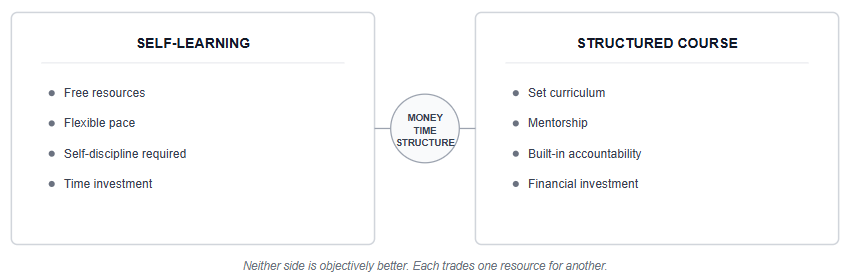
The sticker price is the easy number to compare and the least complete one. A structured program has a visible fee. Self-learning looks free. Neither of those facts is the whole picture.
Self-learning's real cost is time and discipline, not money. The resources are genuinely free or close to it: official documentation, YouTube tutorials, Kaggle's dataset library, freeCodeCamp's data analysis curriculum, and government open-data portals such as data.gov.in. What isn't free is the time spent figuring out what to learn next, in what order, and whether what you just built is actually good, all decisions a structured path makes for you. That time has a real opportunity cost, especially if you're job-hunting on a deadline.
A structured program's real cost is money and a fixed pace, not just the fee. You're paying for someone else to have already made the sequencing decisions, and typically for mentor access, interview preparation, and some form of placement support layered on top of the curriculum itself. The trade you're making is money for structure, not money for guaranteed competence, since no program can force you to actually do the work.
Worth naming honestly, since it's easy to skip past: self-directed learning has a well-documented discipline problem, not because self-learners are less capable, but because open-ended learning without external structure is genuinely hard to sustain. A peer-reviewed analysis of MOOC completion rates found they typically range from under 1% to just over 50%, with a median completion rate of around 12.6%. That statistic describes free, self-paced online courses specifically, not all self-directed learning, and plenty of people build real skills without ever finishing a single course end to end. But it's a fair warning about what "I'll just teach myself" actually requires in practice: not intelligence, but sustained structure you have to build for yourself if nobody else is building it for you.
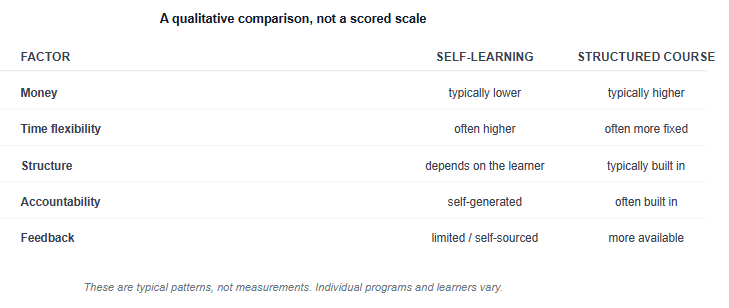
Factor | Self-learning | Structured course |
|---|---|---|
Upfront cost | Close to ₹0 using free resources; a few thousand rupees if you buy one or two paid resources along the way | A meaningful fixed fee, varying substantially by program length, mentorship, projects and placement support |
Time to job-ready | Highly variable; commonly longer than a structured path, and dependent almost entirely on your own consistency | Typically fixed by the program's schedule, with duration varying substantially by provider and format |
Curriculum decisions | Yours to make, which is flexible but also the main place people get stuck or go in circles | Made for you, in a sequence someone has already tested on other learners |
Accountability | Self-generated; genuinely hard to sustain without external structure, per the completion-rate research above | Built in, through deadlines, mentors, or a cohort moving at the same pace |
Feedback on your work | Whatever you can get from communities, forums, or your own judgment | Typically included, from mentors or instructors reviewing actual projects |
Interview preparation | Self-directed, using free interview-question banks and mock interviews you arrange yourself | Usually built into the program, often including mock interviews and resume review |
Portfolio and project structure | You design and validate your own projects, which is a real skill in itself but adds time | Projects are typically pre-designed to demonstrate the right skills to employers |
Best suited to | Highly self-directed learners, tight budgets, flexible timelines, or anyone who already has some technical background to build on | People who want a fixed timeline, built-in accountability, and support they don't have to assemble themselves |
This isn't a hedge. For a specific, fairly common set of readers, self-learning is the more sensible path, not just the cheaper one.
You're genuinely self-disciplined and have proven it before. If you've already taught yourself something substantial, a language, an instrument, a previous technical skill, without an external deadline forcing you, that track record is worth more than any assessment quiz. Discipline is the actual scarce resource in self-learning, and if you already know you have it, most of the argument for paying for structure weakens considerably.
Your budget is genuinely tight and time isn't the constraining factor. If you have more time than money right now, self-learning lets you convert that time into skill without taking on cost you can't comfortably absorb. This is a completely legitimate trade, not a consolation prize.
You already have a meaningfully related technical background. Someone coming from software engineering, finance with heavy Excel use, or a related quantitative field often needs targeted gap-filling, not a full structured curriculum from zero. Self-learning is usually the more efficient path when you're filling specific gaps rather than starting from nothing.
You genuinely enjoy open-ended problem-solving without a guide. Some people do their best learning by getting stuck and figuring their own way out. If that's a real description of how you work, rather than an aspiration, a rigid curriculum can slow you down more than it helps.
The mirror image is just as real, and it isn't about capability either.
You've tried self-learning before and stalled. If you have a history of starting tutorials and not finishing them, that's genuinely useful self-knowledge, not a character flaw, and it's a legitimate reason to pay for external structure rather than trying the same approach again and expecting a different result.
You're working against a real deadline. A career switch funded by limited savings, or a fixed window before a specific opportunity closes, changes the calculation. The fixed pace of a structured program, which can feel restrictive in other circumstances, becomes the actual point when time matters more than flexibility.
You want a specific network or mentor access you can't easily build yourself. Learning from mentors who work at companies you're targeting is difficult to fully replicate through free resources alone, and for some career switches that access is worth real money on its own.
You'd rather spend your energy learning than deciding what to learn. Curriculum design is a genuine skill, and not everyone wants to spend their limited time and energy developing it before they've even started on the actual subject.
Treating self-learning as free. It isn't; it trades money for time and self-generated structure, and undervaluing that trade leads to unrealistic timelines.
Assuming a paid course guarantees an outcome. No program can force the work to happen. A course removes the sequencing and accountability problem; it doesn't remove the need to actually do the work.
Choosing based on price alone. A cheaper program with a thin curriculum and no mentor access isn't automatically a better deal than a more expensive one with real support built in, and the reverse is just as true.
Not accounting for interview prep and portfolio time in either path. Both paths need this work done somewhere; the question is only whether it's built in or something you assemble yourself.
Picking a path based on what worked for someone else on social media. The right answer depends on your own discipline, budget, timeline and background, not on a single success story that may not share your constraints.
Pulling the threads above together, rather than pointing toward one answer:
If discipline is your biggest constraint, honestly assessed rather than hoped for, external structure is often worth paying for, because it replaces the exact thing you know you struggle to generate on your own. If money is the biggest constraint and you genuinely have time and consistency to spare, self-learning is a legitimate trade, not a fallback option. If you already have a strong, related technical foundation, targeted learning to fill specific gaps is often more efficient than either a full structured course or fully open-ended self-study from zero.
It's also worth holding two things in mind that cut against a simple sales pitch in either direction. Neither path guarantees a job; the labour market doesn't check how you learned, it checks what you can do. A paid course doesn't automatically produce a strong portfolio, since a course provides structure, not effort on your behalf. And self-learning doesn't automatically mean a weaker outcome. Plenty of working analysts got there entirely on their own, provided they solved the discipline problem this guide keeps returning to.
If you want a concrete starting sequence rather than a pile of scattered resources, the Data Analyst roadmap lays one out week by week, and the SQL, Excel, and statistics guides on this site are free regardless of which path you choose. If you're closer to the point of proving your skills than learning them, the beginner project ideas are a useful next stop either way.
Quiz
Question 1 of 15
FAQ
FREE COURSES
A statistics course built for working Data Analysts, not a general statistics degree. Every lesson passes one test: would a working analyst actually use this on the job. Four modules take you from descriptive statistics and probability through hypothesis testing to regression, all taught on one continuous fictional retailer's data so techniques build on data you already recognize. Closes with two full end-to-end portfolio projects, each ending in a written business recommendation. No unnecessary mathematical depth, no career filler, every number in every lesson verified against real data before it's written down.
Learn to design data models that power accurate, fast, and trusted analytics. Starting from grain, keys, and relationships, you will build star schemas, track history with slowly changing dimensions, and implement tested dbt projects on cloud warehouses. The course ends with two hands-on portfolio projects. Basic SQL is all you need to start.
An 11-module, project-based course for data analysts who need to work fluently with finance data. Covers financial statements, unit economics, forecasting, valuation, market risk, and fraud analytics, all built around one running case company with real code, data, and a full answer key in every module.