Data Analyst Resume: How to Get Shortlisted
Most data analyst resumes are rejected by a filter before a person ever reads them. Writing for that filter and writing well are not the same skill, and this covers both.
5 Minutes Read
Data Analytics Program — Data Analytics — Next cohort Starts Oct 24 · 35% Discount
Enroll NowMost data analyst resumes are rejected by a filter before a person ever reads them. Writing for that filter and writing well are not the same skill, and this covers both.
Most advice about data analyst resumes focuses on what a hiring manager wants to see. That matters, but it skips a step. At many companies, a resume has to get past an automated system before any hiring manager sees it at all, and the two audiences do not respond to the same things. A resume optimised only for a human reader can lose to a filter it never anticipated. A resume optimised only for a filter can read like a keyword list once a human finally opens it.
This article covers both, in order: what actually happens to a resume before a person reads it, and what makes a person decide to move it forward once they do. Divya, a claims associate at a health insurance company in Ahmedabad applying for her first formal data analyst role, rewrites her resume against this exact framework later in the article. She has never held the title "data analyst," but she has spent two years building reports nobody asked her to standardise. The gap between what she actually did and how she was describing it turned out to be the whole problem.
The scale of automated screening is larger than most job seekers assume, and it is not evenly distributed. Research from Harvard Business School's Project on Managing the Future of Work, published as Hidden Workers: Untapped Talent, found that automated applicant tracking software was used by 99 percent of Fortune 500 firms as of 2019, and that across the US, UK, and Germany, 63 percent of employers surveyed used a recruitment management system to handle applications, rising to 69 percent among larger enterprises. Among employers using such a system, more than 90 percent relied on it to make a first cut or rank candidates before human review, for both middle-skills and high-skills roles.
The mechanism matters as much as the scale. The same research describes these systems as relying heavily on "negative filters," criteria that exclude candidates rather than surface the best ones: an exact degree requirement, a specific employment gap, or the absence of an exact keyword the system was told to look for. A qualified candidate whose resume describes the right experience in different words than the job posting used can be filtered out before anyone reads a single sentence of context.
This has two direct implications for how a data analyst resume should be written. First, match the specific tool names and terms used in the job posting itself. If the posting says "Power BI," write "Power BI," not "business intelligence tools." If it says "SQL," make sure the word appears, not just a description of querying data. Second, keep formatting simple enough for a parser to read correctly. Multi-column layouts, text inside tables, and graphics-heavy templates can be misread or dropped entirely by systems built to extract plain text, which means content that would otherwise pass the keyword check never gets the chance to.
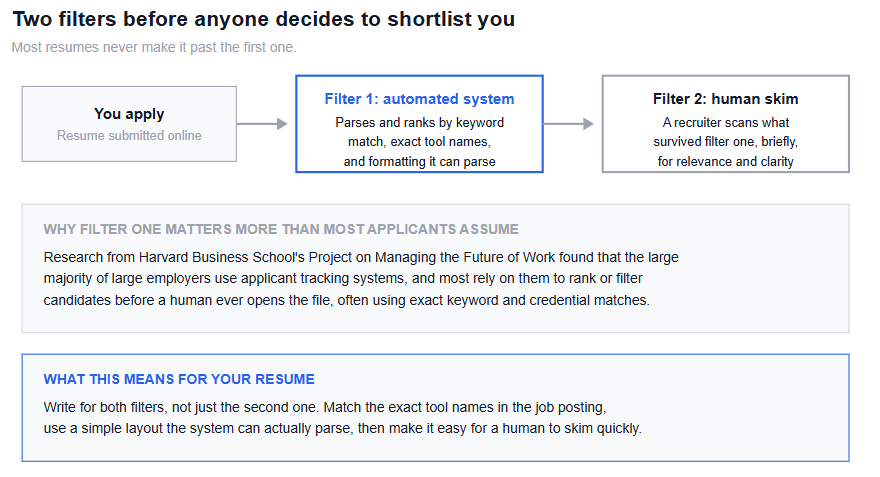
Once a resume clears the automated stage, or reaches a role at a smaller company where a person reads every application directly, the standard changes. A recruiter or hiring manager is skimming for relevance and clarity, not reading closely, and the resume has to make its case quickly.
Lead with a short, specific summary, not a generic objective. A one or two-line professional summary that states your actual experience and top relevant skills does more work than a paragraph about your career aspirations. Career-services guidance from Penn State's engineering career center recommends this kind of summary include quantitative evidence of success stated directly rather than general claims about motivation or work ethic.
Use a reverse chronological structure unless you have a specific reason not to. The same guidance recommends reverse chronological formatting, most recent experience first, as the standard approach for students and recent graduates with limited work history, since it is the format most reviewers expect and can navigate fastest.
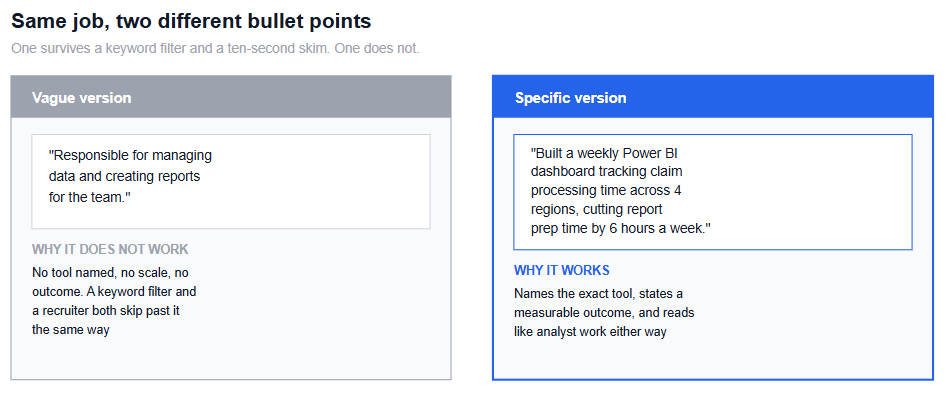
Quantify what you actually did. "Managed reporting" tells a reviewer nothing. "Built a weekly dashboard tracking X, reducing Y by Z" tells them what tool you used, what you built, and what changed because of it. This is the single highest-leverage rewrite available on most resumes, and it costs nothing but a few extra minutes per bullet point.
A skills section listing fifteen tools with no context is weaker than one listing six tools you can actually speak to in an interview. Two rules keep this section useful rather than performative:
List the exact terms used in postings you are targeting, since this is also where the automated keyword match happens most directly. If most roles you want ask for "Power BI" and you know Tableau instead, name Tableau accurately rather than hoping the overlap goes unnoticed.
Do not list a tool you cannot defend in an interview. A resume gets you the conversation. Overstating a skill just moves the moment of discovery from the resume screen to the interview, where it costs more.
If you are switching into data analytics from another role, as Divya was, your work experience section alone may not use the language a recruiter or a filter is looking for. A projects section closes that gap directly, showing analyst-level work even without an analyst-level job title on your resume yet.
The same standard applies here as to the rest of the resume: name the tools, describe the actual problem, and state the outcome. A project section that lists "Sales analysis project" says almost nothing. One that says "Analysed two years of regional sales data in SQL and Power BI to identify a seasonal demand pattern, presented as a three-slide recommendation" gives a reviewer something concrete to remember. If you need a starting point for projects that are substantial enough to describe this way, 20 data analytics project ideas for beginners is scoped for exactly that, and practising with realistic problems first, such as the 15 real-world business SQL problems set, gives you material to describe honestly rather than in vague terms.
Writing one identical resume for every application. Both the automated filter and the human reviewer respond to language that matches the specific posting, and a generic resume matches nothing precisely.
Listing responsibilities instead of outcomes. "Responsible for reports" describes a duty. "Built a dashboard that cut reporting time by six hours a week" describes a result, and results are what get remembered.
Using formatting a parser cannot read. Multi-column layouts, embedded tables, and heavy graphics can cause content to be dropped or scrambled by an automated system, regardless of how good the content actually is.
Naming tools with no evidence behind them. A skills list with no supporting project or experience bullet reads as unverified, and it usually gets tested directly in the interview.
No projects section for candidates without a formal analyst title. This is the section that translates unrelated job experience into analyst-relevant evidence, and skipping it leaves that translation undone.
Treating the resume as finished after one draft. The highest-value edit on most resumes is rewriting vague bullets into specific, quantified ones, and that rarely happens on a first pass.
Divya's original resume described her role at the health insurance company as "handling claims processing and generating reports for the team." Accurate, and almost useless to a reviewer, since it named no tool, no scale, and no outcome, and it would not have matched keywords for a data analyst posting even though the underlying work was genuinely relevant.
She rebuilt the bullet around what she had actually done: built a recurring Excel and Power BI reporting process that tracked claim processing time across four regional teams, which had previously been compiled manually each week. Stated that way, with the tools and the measurable change named directly, the same underlying work read as analyst experience rather than an administrative task. She added a small projects section using a public claims dataset to demonstrate SQL skills the job postings she wanted kept asking for, skills her actual job had not required her to use yet. She also stopped sending the same resume to every posting, adjusting the skills section and summary line to match the specific tools each individual job listed.
None of this changed what she had actually done in her job. It changed whether that work was legible to a filter and memorable to a person, which turned out to be most of what was standing between her resume and an interview.
Once your resume is doing its job, the next filter is the interview itself. 50 data analyst interview questions is a reasonable way to check whether what your resume claims actually holds up under questioning.
If your skills section leans on Excel, make sure it is backed by real fluency rather than surface familiarity. The 25 Excel formulas every data analyst uses list is a fair benchmark for what "Excel skills" should actually mean on a resume claiming them.
And if the gap in your resume is a missing projects section entirely, 20 data analytics project ideas for beginners is built to close exactly that gap with work you can describe specifically rather than vaguely.
Quiz
Question 1 of 15
FAQ
FREE COURSES
An 11-module, project-based course for data analysts who need to work fluently with finance data. Covers financial statements, unit economics, forecasting, valuation, market risk, and fraud analytics, all built around one running case company with real code, data, and a full answer key in every module.
A hands-on path from Python fundamentals to production-grade automation, built for data analysts. Learn to clean messy files, pull data from databases and APIs, generate automated Excel/PDF/PowerPoint reports, and schedule it all to run unattended - then go further with logging, secrets management, and workflow orchestration. Built around one consistent scenario: automating a retail company's weekly sales reporting. Closes with two full portfolio projects using real data and complete worked solutions. No prior programming experience required.
A complete, hands-on path from zero Git knowledge to running a full analytics workflow on GitHub. You'll learn how to track and undo changes safely, branch and merge without fear, collaborate with teammates through pull requests and code review, and handle the parts generic Git tutorials skip: version-controlling Jupyter notebooks and R projects, managing large data files with Git LFS, and structuring a repository so any analyst can pick it up. The course ends with two full portfolio projects: building a reviewed, documented analysis repository from scratch, and publishing an automated, GitHub Pages-hosted analytics portfolio powered by a scheduled GitHub Actions workflow.