Can a BCom Graduate Become a Data Analyst? Skills, Roadmap and Career Options
Yes, a B.Com graduate can become a Data Analyst. But the fastest path is not starting over. It is adding the few technical skills your degree did not cover and using the business knowledge it already gave you.
A B.Com graduate is not starting from zero. Financial literacy, business context, and a real, practical comfort with numbers are genuine assets, and the mistake most guides make is either ignoring them entirely or implying they are enough on their own. Neither is true.
Ritika, a B.Com graduate working as an accounts executive at a small trading company in Lucknow, is working through exactly this transition, and her roadmap runs through this article alongside a broader framework: what she already had, what she genuinely needed to build, and which roles actually rewarded the combination.
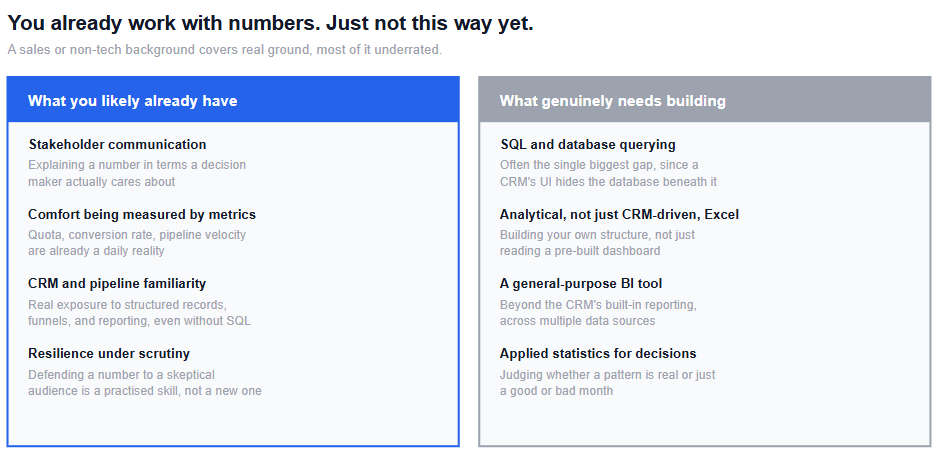
What a B.Com background genuinely already covers
Financial and business literacy. Reading a profit and loss statement, understanding a budget variance, or knowing why a specific cost line matters to a business is not a small thing, and it is not something most technical training covers at all.
Numerical and quantitative comfort. Accounting, costing, and business mathematics build real fluency with numbers, even without formal statistics training. Occupational data on financial analyst roles lists critical thinking, numerical and arithmetic application, and attention to detail among the role's top essential skills, which line up closely with what commerce coursework and accounting-adjacent work already build.
Basic spreadsheet familiarity. Most B.Com programmes and early finance roles involve some Excel exposure, even if it stops at basic formulas and data entry rather than genuine analysis. This is a real head start over a true cold start, even though it is not yet the functional skill a job posting is asking for.
Business context and judgement. Knowing why a number matters to a business, not just how to calculate it, is closer to what analyst work actually requires day to day than most technical skill lists suggest.
What genuinely needs to be built
SQL and database querying. This is often one of the biggest technical gaps, though not universal; some B.Com graduates pick up SQL independently or through an internship. Commerce coursework rarely touches databases as a standard part of the syllabus, and for most graduates this is the single most consistent skill separating them from being interview-ready for analyst roles.
Functional, analytical Excel. Pivot tables, lookup functions, and structured formulas are a different skill from the basic data entry and simple formulas most commerce coursework covers, and the gap between the two is usually larger than it looks from the outside.
A BI tool such as Power BI. Turning a spreadsheet into a dashboard someone else can actually use and interpret is a specific, learnable skill, not an automatic extension of Excel competence.
Applied statistics for business decisions. Beyond the level of math covered in commerce coursework, this means judging whether a pattern in the data is real or just noise, a specific kind of skepticism worth building deliberately rather than assuming it comes from being good with numbers generally.
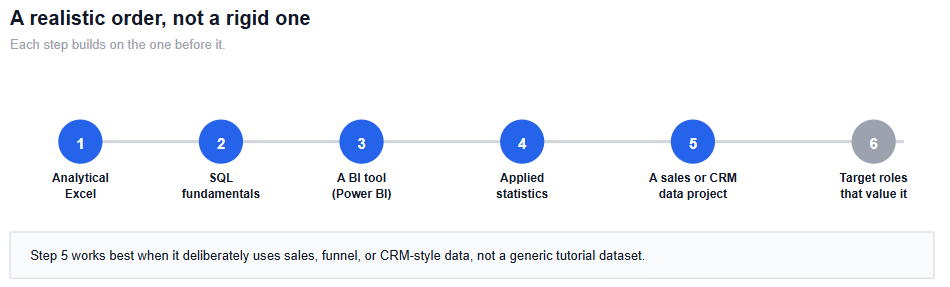
A realistic roadmap
1. Functional Excel first. This builds on what already exists rather than starting cold, and it is the fastest early win since the starting point is genuinely closer than zero.
2. SQL fundamentals. This is the actual new skill, and it deserves real, deliberate practice rather than a single weekend course. The 15 real-world business SQL problems set is built around realistic, ambiguous questions rather than isolated syntax.
3. A BI tool. Power BI is a reasonable default because it is widely used for business reporting and dashboarding; Microsoft's own documentation describes it as a business intelligence solution for turning data into coherent, visually immersive, and interactive insights shared across an organisation. This is where the Excel and SQL skills start turning into something a stakeholder can actually use.
4. Applied statistics. Enough to recognise when a business conclusion needs more scrutiny before being trusted, not a full academic statistics course.
5. A project grounded in finance or business data. This is where the commerce background becomes a genuine advantage rather than a neutral fact on a resume. A project analysing sales trends, expense patterns, or a public financial dataset lets the existing domain knowledge do real work, rather than analysing a generic dataset unrelated to it.
6. Target roles that actually value the combination, covered next, rather than applying only to generic analyst postings where the commerce background adds nothing extra.
Career options that fit this background well
Role | What it involves | Why a commerce background fits |
|---|
Business Analyst | Combining business context with data-driven recommendations for stakeholders | Understanding business operations and financial context directly |
MIS or reporting analyst | Building and maintaining recurring business reports and dashboards | Existing reporting literacy and comfort with structured data |
Financial or FP&A analyst | Data-heavy financial planning, budgeting, and forecasting support | Direct overlap with accounting and finance coursework |
General data analyst | Cross-industry analysis, less tied to a specific business domain | Requires the most new technical skill relative to domain fit |
Marketing or sales analytics analyst | Analysing revenue, campaign, or customer data for business decisions | Business fundamentals transfer, though less directly than finance roles |
None of these roles is automatically easier to get than another, but the first three align especially well with the business and financial context a commerce background provides, rather than just the new technical skills layered on top of it. Career-guidance data on management and business analyst roles describes gathering and analysing financial and operational data, then recommending solutions to stakeholders, as core to the role, which maps closely onto what commerce coursework and finance-adjacent work already build. It is also worth noting that official occupational data for the broader business intelligence analyst category lists a wide range of technical tools, from SQL and Excel to Power BI and Tableau, without naming a specific required degree field, which is consistent with demonstrated skill mattering more than the specific degree on the general data analyst path.
Common mistakes to avoid
Skipping straight to advanced tools without functional Excel first. This skips the fastest, lowest-cost win available given the existing starting point.
Avoiding SQL because it feels "too technical." This is the single most consistent gap standing between a commerce background and being interview-ready, and it does not go away by working around it.
Applying only to generic analyst postings. This wastes the one genuine, differentiated advantage many B.Com graduates have: real financial and business context.
Undervaluing the existing background entirely. Treating the degree as irrelevant, rather than as a real starting point, leads to spending time re-learning things that were already covered.
The opposite mistake: assuming business literacy alone is enough. Numerical comfort and SQL fluency are different skills, and one does not substitute for the other.
Building a portfolio project unrelated to finance or business. This misses the chance to demonstrate the exact combination that makes the background valuable in the first place.
How Ritika built her roadmap
Ritika's daily work already involved reconciling expense reports and building monthly variance summaries in Excel, which felt routine to her but, once she looked closely, already demonstrated real business and numerical judgement. What she did not have was any exposure to SQL or a BI tool, and her Excel use, while regular, rarely went beyond basic formulas.
She spent the first six weeks specifically on functional Excel, pivot tables and lookup functions applied to her own company's sales data, before starting SQL. The order mattered: by the time she reached SQL, she already understood the underlying business questions well enough to focus entirely on the new syntax rather than also learning what the data meant. She built her portfolio project around a public dataset of small business expense categories, deliberately choosing something close to her own domain rather than a generic tutorial dataset, and used it to practise both her new SQL skills and dashboard-building in Power BI.
When she started applying, she specifically targeted business analyst and MIS analyst postings at mid-sized companies rather than broad "data analyst" listings at large technology firms, reasoning correctly that her accounting background would matter more there. It did. Her first interview was for an MIS analyst role, and the interviewer's first real question was about how she would design a monthly expense variance report, a question her actual work experience answered more convincingly than any amount of tutorial practice would have.
Where to go from here
If functional Excel is the first gap to close, the 25 Excel formulas every data analyst uses list is a reasonable benchmark for what that should actually include.
Once Excel feels solid, your first 10 SQL queries is a reasonable place to start the genuinely new part of this roadmap.
And for the BI tool stage, Power BI for beginners covers the depth a first dashboard-building project should reach.