How to Present Bad News From Your Analysis to Senior Leaders
A practical guide for analysts who need to deliver uncomfortable findings without losing credibility, trust, or the room
5 Minutes Read
Data Analytics Program — Data Analytics — Next cohort Starts Oct 24 · 35% Discount
Enroll NowA practical guide for analysts who need to deliver uncomfortable findings without losing credibility, trust, or the room
The campaign underperformed. The feature didn't lift retention. The metric everyone thought was trending up has actually been declining for three months. You've checked the data twice. The finding is solid. And now you have to walk into a room full of people who were expecting good news and tell them the opposite.
This is one of the most uncomfortable situations a data analyst faces, and one of the most consequential. How you handle it determines whether you're seen as a trusted source of truth or a problem to be managed around. Analysts who consistently deliver bad news clearly, confidently, and constructively become the people senior leaders want in the room before decisions are made. Analysts who soften findings until they lose their meaning, or who deliver them in a way that triggers defensiveness rather than action, get quietly removed from the conversation.
The mechanics of delivering bad news well are learnable. This guide covers what makes it hard, a structure that makes it easier, the most common mistakes analysts make, and the specific habits that build the kind of credibility where difficult findings are welcomed rather than resisted.
Bad news from data is different from other kinds of bad news because it often challenges something a senior leader chose, advocated for, or publicly committed to. A campaign that underperformed wasn't just a project. Someone approved the budget, the creative, and the targeting strategy. A feature that failed to move retention wasn't just a hypothesis. An engineering team spent two sprints building it and a product manager presented it to leadership as a priority.
When analysis shows that something didn't work, it is often landing in a room where multiple people have a stake in it having worked. The natural human response to that situation is not "thank you for this data." It's to question the methodology, point to external factors, ask whether the time window was long enough, or suggest that the metric chosen was the wrong one.
This is not irrational. It's predictable. And the analyst who walks in without accounting for it will consistently be surprised by the reaction.
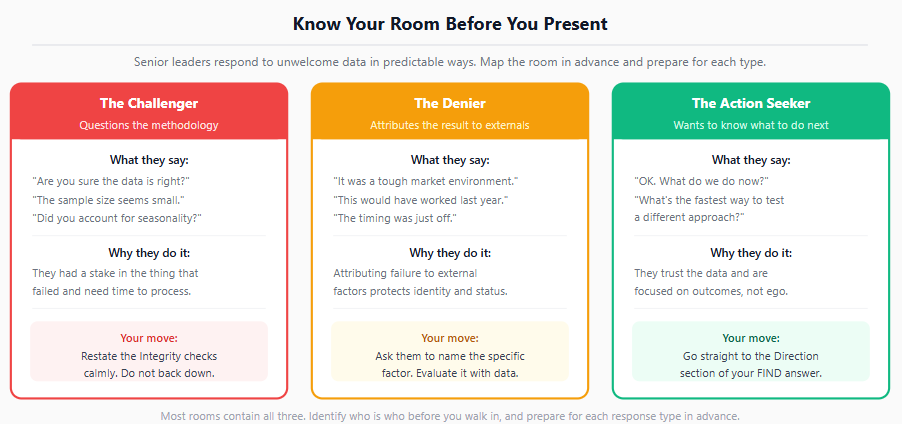
Understanding the room before you present is as important as understanding the data. Who championed the thing that failed? Who will be most affected by the finding? Who in the room is likely to ask "are you sure?" and who is likely to immediately ask "what do we do now?" Mapping this in advance shapes every choice about how to frame, sequence, and deliver the finding.
Bad news delivered on shaky analytical foundations is the worst possible outcome. It gives everyone in the room who doesn't want to believe the finding a legitimate reason to dismiss it.
Before walking into any room with a negative result, run three checks.
Check 1: Verify the finding is real.
This means more than re-running the query. It means asking: could this result be explained by a data quality issue? Is there a pipeline refresh problem, a duplicated join, or a NULL being treated as zero that could be producing this number? Could the time window be too short to distinguish a real trend from noise? Is the metric the right proxy for what the business actually cares about?
Understanding the most common reasons analytics findings go wrong before you present protects you from the worst possible version of delivering bad news: discovering in the room, under pressure, that your number was wrong.
Check 2: Anticipate the obvious alternative explanations.
Senior leaders will raise them whether you do or not. If there's a seasonal pattern that could explain the dip, address it. If the sample size was smaller than ideal, acknowledge it. If there's an external market factor that happened during the measurement window, name it and explain why it doesn't change the core finding. Proactively ruling out the alternatives is not a sign of uncertainty. It's a sign of analytical rigor.
Check 3: Have at least one forward path ready.
Delivering a finding without any sense of what to do next puts the entire burden of response onto the leadership team in real time. You don't need a complete solution. You need enough of a forward path that the conversation can move from "what happened" to "what now." Even "the data points to two possible explanations, and here's what we'd need to investigate to distinguish between them" is sufficient. It moves the room.
Most analysts default to one of two bad patterns when delivering unwelcome results. The first is the slow reveal: twenty minutes of context, methodology, and data exploration before the actual finding lands on slide 19, by which point the audience has already sensed something is wrong and is anxious rather than prepared. The second is the abrupt drop: one slide, one number, no framing, no context, no path forward. The first loses the room to dread. The second loses it to shock.
A structure that works consistently is what we call FIND:
F: Finding: state the result plainly and early
I: Integrity: explain why the finding is credible
N: Nuance: add the relevant context, caveats, and what the finding does not mean
D: Direction: close with what this means for what happens next
This structure front-loads the finding so the audience knows what they're dealing with from the first thirty seconds, spends the middle building confidence in the credibility of the result and its proper interpretation, and closes on action rather than on the bad news itself. The last thing the room hears is not the problem. It's the path forward.
State the result in one or two sentences, in plain language, as the very first thing you say after any minimal context-setting. Do not warm up the room with good news first. Do not open with methodology. Open with the finding.
Weak: "So we ran the analysis over the past 60 days and looked at a few different metrics and what we found was kind of interesting actually, there are some things that went well and some things that didn't, so let me walk you through the data..."
Strong: "The short version is that the campaign did not move conversion rates. Across all three audience segments, conversion stayed flat within the margin of noise. I want to walk you through how we verified that, what it doesn't tell us, and where I think we go from here."
The second version gives the room the finding immediately, signals that the analyst is confident in it, and tells the audience what the next few minutes will accomplish. It removes the dread of waiting for the bad news and replaces it with the clarity of knowing what they're dealing with.
Before the room has time to question your methodology, you give them the answer. This is the single most important section for managing resistance, because the most natural response to unwelcome data is to challenge the data rather than accept the conclusion.
Cover, briefly: the data source, the time window, the metric and why it was the right one to measure, and the one or two alternative explanations you checked and ruled out. Keep this tight. Two to four minutes maximum. The goal is not to give a methodology lecture. It's to make the finding harder to dismiss.
What to say: "This is based on event-level data from our analytics warehouse, covering 84 days post-launch. We looked at conversion specifically because that was the stated campaign objective, and we cut the data three ways: by channel, by device, and by cohort. We also checked whether the flat conversion was being masked by a mix shift, and it wasn't. The pattern holds across segments."
What not to say: "We're pretty confident in these numbers" without evidence. Confidence claims without supporting reasoning invite challenges, not acceptance.
Bad news almost never means exactly what a first reading suggests. This is where you prevent overreaction, protect against misinterpretation, and add the honest complexity that makes the finding more useful rather than less.
Nuance in this context means three things:
What the finding does not mean. "This doesn't mean the product is broken. It means this particular campaign approach didn't generate the lift we were targeting in this window."
What we genuinely don't know yet. "We can't tell from this data whether the issue is in the creative, the targeting, or the channel mix. Distinguishing those three would require a structured test."
What is still true. "The retention metrics for users who did convert through the campaign are actually stronger than the baseline cohort, which is an interesting signal worth tracking."
This section prevents the most common post-presentation failure: the finding gets taken as a verdict on something much larger than what was actually measured.
The last thing the room should hear is not a confirmation of how bad things are. It's a concrete sense of what to do with the information. Direction does not require a complete solution. It requires enough of a path that the room can orient toward action rather than staying anchored to the bad news.
Direction takes one of three forms:
A recommendation: "Based on what we found, I'd suggest pausing the campaign spend and running a structured creative test before the next cycle."
A decision the data can't make for you: "The data tells us what didn't work. Whether to reallocate the budget to channel B or run another test in channel A is a business call that depends on appetite for risk and the timeline, which I don't have full visibility into."
The next analytical step: "The most useful thing we could do analytically is isolate whether the issue is in awareness or in conversion, and here's the test design I'd recommend to answer that in four weeks."
Ending on direction is what separates a finding that drives action from a finding that just creates discomfort with no outlet.
The tone of a difficult findings presentation is one of the things analysts most commonly get wrong, usually in one of two directions.
The first is over-apologetic: "I'm sorry to have to share this," "I know this isn't what we were hoping for," "I feel bad bringing this to the group." This tone signals that the analyst views the finding as their failure, which invites the room to treat it that way. It also positions the analyst as emotionally invested in the outcome, which undermines the perception of objectivity.
The second is clinical detachment that ignores the human reality of the room: presenting a major miss as if it were a routine status update, with no acknowledgment that what you're describing has real consequences for people's work and decisions.
The right tone is honest, neutral, and forward-looking. It acknowledges the significance of the finding without treating it as a catastrophe and without treating it as the analyst's personal failure. It sounds like someone who is on the same side as the room, not someone who has come to deliver a verdict.
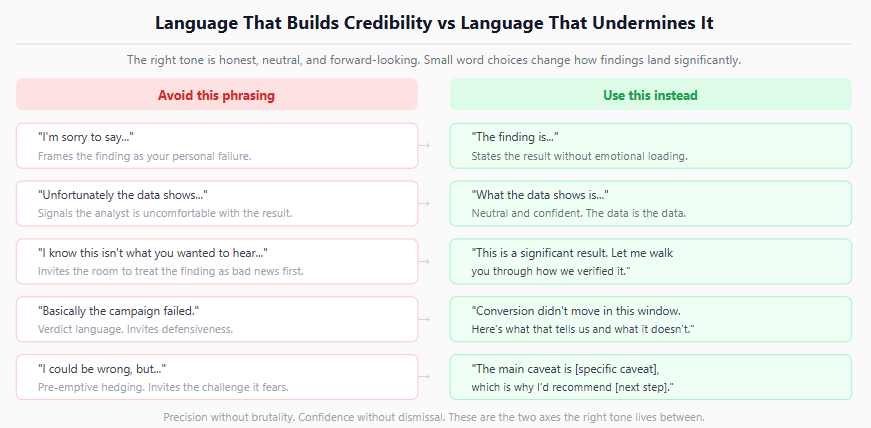
Some specific language patterns worth building into your muscle memory:
Avoid | Use instead |
|---|---|
"I'm sorry to say..." | "The finding is..." |
"Unfortunately the data shows..." | "What the data shows is..." |
"I know this isn't what you wanted to hear..." | "This is a significant finding, so let me walk you through how we verified it." |
"Basically the campaign failed." | "Conversion didn't move in this window. Here's what that tells us and what it doesn't." |
"I could be wrong but..." | "The main caveat is [specific caveat], which is why I'd recommend [specific next step]." |
The goal is language that is precise without being brutal, and confident without being dismissive of the significance of what you're reporting.
Even with perfect preparation and framing, some rooms push back hard. Knowing how to handle specific types of reactions in real time is what separates analysts who build credibility through difficult moments from those who lose it.
"Are you sure the data is right?"
This is the most common response and almost always the first line of defence from someone who doesn't want to accept the finding. The preparation you did in the Integrity section is your answer. Restate it calmly and specifically: "Yes. Here's what we checked and here's why the result holds." Do not get defensive. Do not back down. Do not say "I think so." You checked before you walked in the room. Say so.
"This is just one campaign. You can't generalise from this."
Acknowledge the scope limitation honestly, then hold the finding: "You're right that this is one campaign, and I'm not claiming it tells us something universal about our approach. What it does tell us is that this specific campaign, in this window, did not move conversion. That's still useful to know before we renew the spend."
"There must be external factors."
Ask what factors they have in mind. If there are specific external events, evaluate them. If the concern is vague, hold the finding: "If there's a specific market event you think could have affected the results, I'd want to look at that. In the absence of a specific factor, the data we have doesn't support the conversion dip being driven by external causes."
"Can we see a version of the data that shows something positive?"
This is the most dangerous request because it's framed as reasonable and is actually a request to cherry-pick. The right response is gentle and clear: "I can absolutely show you where the positive signals are in the data, and there are some. But I'd want to make sure we're not building next quarter's plan on signals that are exceptions rather than patterns. Can I show you both, and flag which is which?"
Someone senior disagrees loudly and the room shifts.
Stay calm and stay with the data. "I hear that, and I want to make sure we're working from the same information. Can I show you the specific cut that's driving that finding so we're looking at the same thing?" Do not capitulate to authority. Senior leaders who later find that their pushback caused an analyst to soften a real finding will trust that analyst less, not more.
The single most valuable thing you can do before a high-stakes difficult finding is brief the most senior person in the room privately, before the meeting. This is not asking for permission to deliver bad news. It's professional courtesy that prevents the most dangerous dynamic in any leadership meeting: public surprise.
When a senior leader hears genuinely bad news for the first time in front of their peers, their instinct is often to protect themselves by challenging the data rather than engaging with the finding. A private briefing removes that dynamic. It gives them time to process before they have to respond in public. It also gives you the opportunity to hear their initial questions and sharpen your answers before the room.
Being fluent in Python-based analysis and automation helps here too: having a reproducible, auditable analysis you can walk someone through end-to-end in five minutes is more persuasive than a static slide. When someone asks "can you show me that?" in a private briefing, being able to open the notebook and demonstrate the answer in real time builds confidence in the finding that no amount of slide polish can match.
Keep slides clean and finding-first. The slide that states the finding should not be buried. It should be the first substantive slide, after any context that's genuinely necessary. No more than two or three data points per slide. Nothing that requires the audience to look at a table for thirty seconds to understand what you're showing.
The most important discipline during the presentation is to not flinch. Silence after a difficult finding is normal. You don't need to fill it immediately. Let the finding land. Count to three mentally before adding anything. The instinct to fill silence with softening language ("but of course, there are lots of ways to interpret this...") is the instinct most likely to undermine your credibility in the moment.
Follow up with a written summary of the finding, the key integrity checks, the nuance, and the recommended next step. This does two things: it gives people who were processing during the presentation a chance to review the finding on their own terms, and it creates a documented record of what was said. Analysts who deliver difficult findings clearly in writing, not just verbally, build a reputation for rigour that compounds over time.
There is a longer-term dynamic worth naming explicitly. Analysts who only ever bring good news, or who soften findings until the difficult signal is lost, train the people around them to expect comfortable data. This feels safe in the short term and is quietly corrosive in the long term, because it means leadership is making decisions on a filtered view of reality.
Analysts who consistently deliver difficult findings clearly, confidently, and with a path forward become something more valuable than a reporting function. They become a source of truth that senior leaders actively protect and consult, because they know that what they're hearing is real.
The willingness to walk into a room with data that contradicts what the room wants to hear, and to hold that position calmly under pressure, is one of the rarest and most valuable skills in analytics work. It is also, in a straightforward sense, what the job is actually for.
For a broader view of how communication and framing choices affect whether analytical work drives decisions, the piece on why analytics projects fail covers the full pattern: bad news delivered poorly is one instance of a much wider problem of analytical output that doesn't change what organisations do.
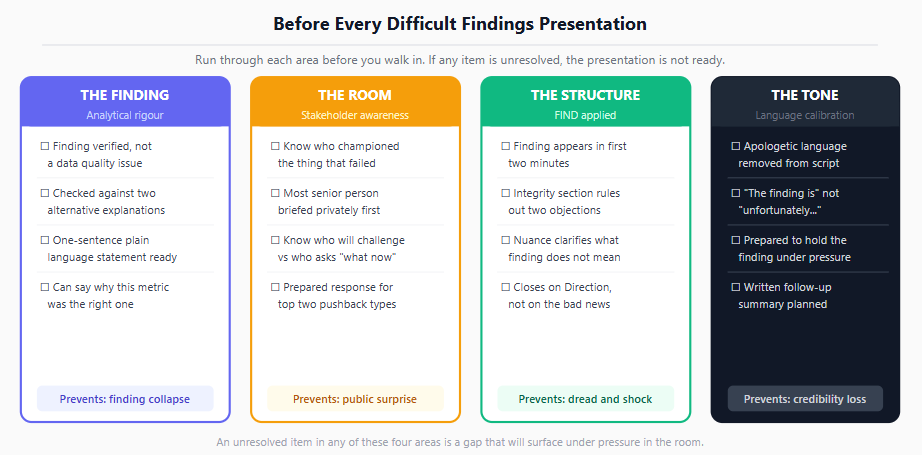
The finding
Have you verified the finding is real, not a data quality or pipeline issue?
Have you checked the result against at least two alternative explanations?
Can you state the finding in one sentence, in plain language, without technical jargon?
The room
Do you know who championed the thing that failed?
Have you briefed the most senior person privately before the meeting?
Do you know who in the room is likely to challenge and who is likely to ask "what now?"
The structure
Does the finding appear in the first two minutes, not the last?
Have you included an Integrity section that proactively rules out the obvious challenges?
Have you added Nuance about what the finding does not mean?
Does the presentation close on Direction, not on the bad news itself?
The tone
Have you removed apologetic language from the script?
Have you prepared calm, specific responses to the two most likely pushback scenarios?
Is there a written follow-up planned to document the finding and the recommended next step?
The skills in this article sit at the intersection of analytical rigour and stakeholder communication. On the rigour side, the foundation is being confident enough in your analysis to hold a finding under pressure. The SQL for Data Analysts guide is the starting point for building that technical confidence. On the communication side, understanding what makes analytical output drive decisions (rather than get filed away) connects directly to the broader patterns of why analytical work fails to change what organisations do.
For analysts who want to develop the full range of skills needed to work effectively with senior stakeholders, the data analyst career roadmap for 2026 covers the technical and non-technical skills that make the biggest difference at each career stage.
Quiz
Question 1 of 15
FAQ
FREE COURSES
A hands-on course that takes you from BI foundations to KPI design, SQL calculation, dashboards, data quality, experiments, and clear communication of insights. Every lesson uses worked examples, exercises, and interview questions. The description is two sentences. If you want it shorter, use: "Learn to design, calculate, analyze, and present KPIs, from BI foundations to dashboards, data quality, and experiments."

This hands-on Pandas course takes you from your first DataFrame to writing efficient, production-ready data analysis pipelines. Learn data cleaning, transformation, aggregation, merging, time series, reshaping, and performance optimization using one realistic e-commerce dataset. Build five complete portfolio projects covering sales, customer cohorts, inventory, revenue trends, and survey analysis. By the end, you'll confidently handle and analyze real-world data for data analyst and data science roles.

This project-driven course takes you from zero Python experience to job-ready data analyst skills. Learn Python, NumPy, pandas, visualization, EDA, statistics, databases, automation, and practical machine learning through a real-world business scenario. Build five end-to-end portfolio projects across retail, churn, marketing, finance, and HR analytics. Finish with career guidance, role expectations, and current compensation insights to prepare for the job market.