Python for Data Analysis

This project-driven course takes you from zero Python experience to job-ready data analyst skills. Learn Python, NumPy, pandas, visualization, EDA, statistics, databases, automation, and practical machine learning through a real-world business scenario. Build five end-to-end portfolio projects across retail, churn, marketing, finance, and HR analytics. Finish with career guidance, role expectations, and current compensation insights to prepare for the job market.

author

Rutvik Acharya

Principal Data Scientist

Atlassian

Loading modules...

What You'll Learn

Write clean, professional Python code — from core syntax through OOP, error handling, and Git

Manipulate and clean real-world data at scale using NumPy and pandas

Build clear, persuasive visualizations and run statistically sound EDA and hypothesis tests

Query databases, automate reports, and build simple predictive models with scikit-learn

Who Should Attend

Beginners with no prior programming experience who want a career in data analysis

Excel/spreadsheet analysts looking to level up to Python and handle larger, messier data

Career changers preparing for data analyst interviews and portfolio reviews

Professionals in adjacent roles (marketing, finance, operations) who want to self-serve their own data analysis

CERTIFICATION

Certificate of Completion
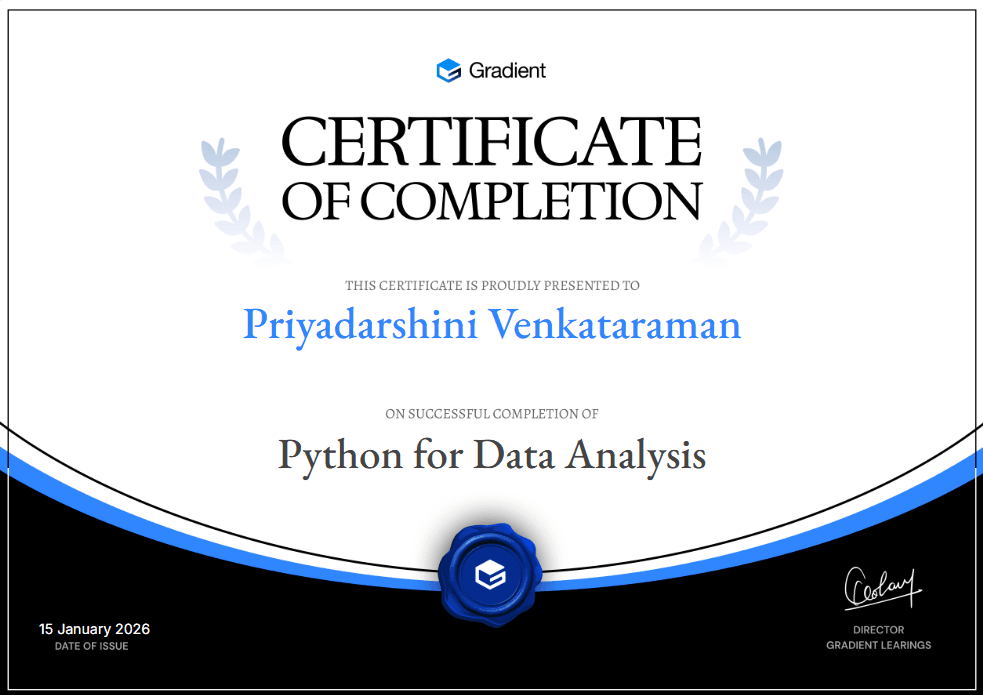
Certificate of Participation
Course
9 Modules
33 Hours
66 Lessons
66 Challenges
Language: English

FAQ

FREQUENTLY ASKED QUESTIONS

No. The course starts from first principles with Python fundamentals — variables, data types, loops, and functions — and builds up step by step to NumPy, pandas, visualization, statistics, and machine learning basics. No coding background is required.
You'll install Anaconda, which bundles Python along with Jupyter Notebooks and the core data libraries used throughout the course, including NumPy, pandas, and Matplotlib. Setup instructions are covered in the first module.
The course spans 9 modules and 66 lessons, totaling approximately 33 hours of content. Most learners work through it over several weeks, pacing themselves according to their own schedule.
Yes. Every module uses a single running business scenario, Gradient Retail, so the skills you learn build on each other in a realistic context rather than feeling like disconnected exercises. You'll practice cleaning, analyzing, and visualizing data the way you would on the job.
The course includes a practical introduction to machine learning in the final module, covering the scikit-learn workflow, train/test splits, linear regression, basic classification, and model evaluation metrics. It's designed to give analysts enough ML literacy to build simple models and work effectively with data science teams, not to make you a machine learning engineer.
Scroll Up
GET FREE CAREER COUNSELING