Can an Engineer Switch to Data Analytics? How to Use Your Existing Skills
Some engineering skills transfer directly. Others only feel like they should, and that false confidence is what actually slows the switch down.
5 Minutes Read
Data Analytics Program — Data Analytics — Next cohort Starts Oct 24 · 35% Discount
Enroll NowSome engineering skills transfer directly. Others only feel like they should, and that false confidence is what actually slows the switch down.
The short answer is yes, and it is one of the more natural transitions into data analytics that exists. The longer, more useful answer is that "engineer" covers a wide range of backgrounds, and the skills that genuinely transfer are not always the ones that feel like they should. Some real overlap gets underused because it does not look like the thing being asked for. Some assumed overlap turns out to be false confidence that only becomes visible a few weeks into the job search, or worse, a few weeks into the job.
This matters because the failure mode for engineers switching into analytics is rarely "not smart enough." It is usually "assumed the wrong things transferred automatically, and built confidence in the wrong direction."
Karan, an illustrative mechanical engineer working in quality control at an auto-parts manufacturer in Nashik, is switching toward a manufacturing-and-supply-chain-focused analyst role. His situation runs through this article because it surfaces a genuinely useful distinction: which of his engineering instincts were actually helping him, and which ones he had to unlearn before they got in the way.
Three things carry real, direct weight, regardless of engineering discipline.
Quantitative reasoning. Comfort with numbers, formulas, and structured logic is not something most career changers have to build from nothing, and engineers generally do not either. This shows up immediately in how quickly SQL syntax and spreadsheet formulas get picked up, even if the underlying thinking still needs adjustment, covered below.
Structured problem-solving. Breaking an ambiguous problem into smaller, testable pieces is a real, transferable habit, and it is close to the core of what an analyst actually does with a vague business question.
Attention to detail. Government occupational data on mechanical engineers lists attention to detail and critical thinking among the role's top essential skills, alongside numerical and arithmetic application, which line up closely with what O*NET's own data lists as essential for business intelligence analyst roles: critical thinking, mathematics, and reading comprehension. The overlap here is real and independently documented on both sides, not just a comforting assumption.
Domain expertise, when aimed correctly. An engineering background in manufacturing, supply chain, or another process-heavy field is a genuine advantage for an analyst role in that same domain specifically. It adds nothing extra for a generic analyst posting unrelated to that background, which matters for where to actually apply, covered later in this article.
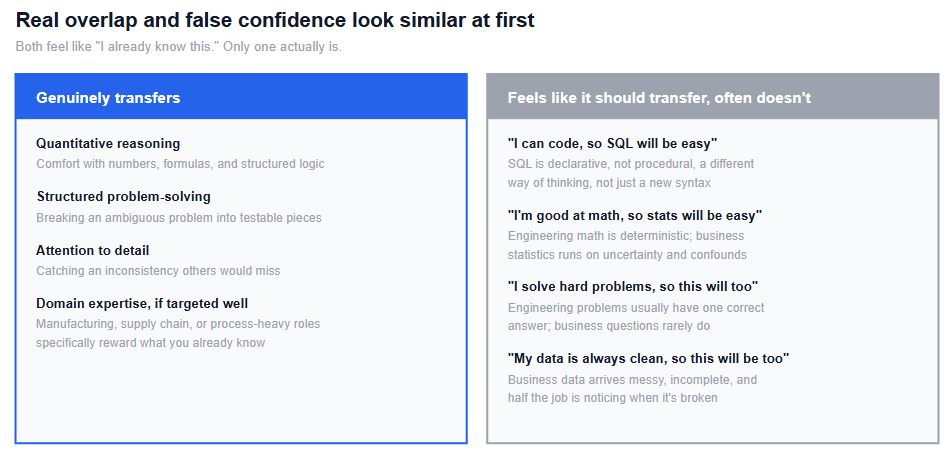
This is the part worth reading slowly, because each of these is a genuinely reasonable assumption that turns out to be only partly true.
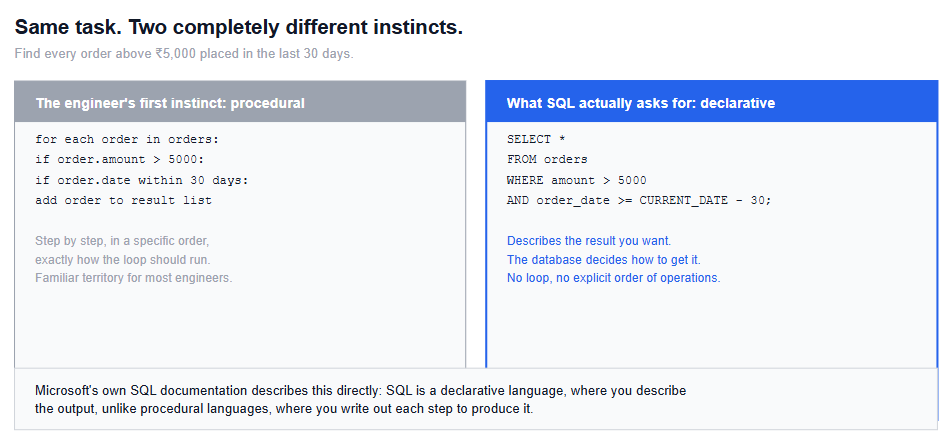
"I can already code, so SQL will be trivial." Partly true, and partly a trap. Microsoft's own SQL documentation is explicit that SQL is a declarative language, where the query describes the result you want, in contrast to procedural languages, where the code specifies the exact sequence of steps to produce it. This is not just a Microsoft-specific framing; PostgreSQL's own documentation describes the SQL language itself as grounded in relational algebra and the tuple relational calculus, operating on entire sets of rows through set-based operations rather than a step-by-step procedure. An engineer used to writing loops and conditionals often starts by mentally translating SQL into procedural logic, which works for simple queries and breaks down fast once joins, aggregations, and subqueries are involved. The syntax is genuinely learnable quickly. The shift in thinking underneath it takes real, deliberate practice.
"I'm good at math, so statistics will be easy." Engineering mathematics is frequently deterministic: given the inputs, there is a correct answer, and the goal is finding it precisely. Business statistics runs on a different logic entirely, sampling, uncertainty, confounding variables, and the constant question of whether an observed pattern is real or coincidental. Strong engineering math skill makes learning this faster. It does not make the underlying skepticism automatic, and an engineer's confidence with numbers can occasionally work against them here, producing a plausible-sounding conclusion from a correlation without checking for confounds the way engineering data rarely requires.
"I solve hard technical problems for a living, so business problems will be similar." Many engineering problems are framed around a measurable technical constraint or a verifiable outcome, while business analytics questions are often more ambiguous: the metric definition is contested, the stakeholders want different things, and there may be no single correct answer, only a defensible one. This is a real, different skill, closer to negotiation and framing than to calculation.
"My data is always accurate, so this will be too." Engineering data typically comes from instruments with known tolerances, or from a controlled process. Business data comes from humans, legacy systems, and processes nobody fully documented, and a meaningful part of an analyst's job is noticing when the data itself is the problem before trying to answer the actual question. This is not just an accuracy check; data quality is commonly assessed across several distinct dimensions, including completeness, consistency, timeliness, and validity, not accuracy alone, which means a dataset can be numerically correct and still be unusable if it is missing rows, inconsistently formatted, or out of date.
Before assuming any of the above applies to your specific situation, start with an honest assessment, then verify it with three concrete checks.
Assess which specific skills you are assuming transfer, without checking. Go through the list in the previous section against your own background: which of the four false-confidence assumptions are you currently making, and which of the genuine transfers are you actually relying on versus just hoping are true. This step costs nothing but honesty, and it determines where the rest of your preparation time should go.
Build one portfolio project using real, messy data, not a clean dataset. A tutorial dataset with no missing values or inconsistencies will not tell you whether you actually enjoy the ambiguous parts of this work. 20 data analytics project ideas for beginners is scoped to produce exactly this kind of realistic evidence.
Practise SQL against realistic business questions, not just syntax. This is where the procedural-to-declarative shift actually gets tested. The 15 real-world business SQL problems set is built around ambiguous, business-shaped questions rather than isolated syntax drills.
Build enough statistical judgment to catch your own overconfidence. Given how strong engineering math tends to be, the specific gap is usually not calculation, it is knowing when a pattern needs more scrutiny before being trusted. Statistics for data analysts covers that judgment layer directly.
Assuming coding ability fully substitutes for SQL fluency. The syntax is fast to pick up. The declarative, set-based thinking underneath it is a separate skill worth practising deliberately.
Practising only on clean, structured data. This produces false confidence, since the actual job spends real time on data that is incomplete or simply wrong.
Underestimating the ambiguity in business questions. Treating a business problem like an engineering problem, assuming there is one correct answer waiting to be found, leads to overconfident, narrow conclusions.
Applying only to generic analyst postings. This wastes the one genuine, differentiated advantage many engineers have: real domain expertise in a specific industry or process.
Skipping communication practice. Explaining a finding to a non-technical stakeholder is a different skill from writing a technical specification for another engineer, and it does not automatically come from technical competence.
Overestimating how much statistics knowledge transfers. Strong engineering math does not automatically produce the skepticism business statistics requires around confounds, sample size, and correlation versus causation.
Karan's first instinct was to assume the switch would be mostly about learning new tools, since he was already comfortable with data, calculations, and structured analysis from years of quality control work. His first attempt at SQL practice made the gap obvious quickly: he kept mentally writing loops before translating them into queries, which worked for simple filters and fell apart once he needed to join defect data across multiple production lines.
Rather than treating this as a setback, he used it as a signal to practise SQL specifically as its own way of thinking, working through realistic multi-table problems instead of isolated syntax exercises, until querying stopped feeling like translated code and started feeling native. He also built a portfolio project analysing a public manufacturing defect dataset, deliberately choosing one with inconsistent formatting and missing values rather than a clean one, to test whether he could tolerate the ambiguity rather than just the math.
The most consequential decision was where he applied. Rather than sending his resume to generic analyst postings, he specifically targeted manufacturing and supply chain analytics roles, where his years of hands-on quality control experience, understanding what a defect rate actually means on a production floor, translated directly into a real, differentiated advantage.
Disclosure: Gradient Learnings publishes this article, and the programme described below is our own.
The pathway this article describes, honestly assessing what transfers, closing the specific gaps, and proving it with real work, is exactly what Gradient's current data analytics programme is structured around, so it is worth laying out plainly rather than leaving the connection implicit.
Your existing engineering skills are the starting point, not the destination. Quantitative reasoning and structured problem-solving get you in the door faster than most career changers. The programme's SQL, Excel, Python and Pandas, and Tableau or Power BI modules are where those instincts get redirected, specifically the declarative SQL shift and the statistical judgment layer this article covers, rather than assumed to already be there.
Business cases replace clean, deterministic problems. The curriculum is built around real-world case studies rather than isolated syntax exercises, which is the same shift from "one correct answer" to "a defensible answer" this article argues engineers need to practise deliberately.
Projects replace assumptions. Four or more real-world projects, plus an AI-powered capstone, are the structured version of the "build one project on real, messy data" test this article recommends running on your own. The difference is having weekly assignments and deadlines that force it to actually get finished, rather than staying a good intention.
Mentorship covers the gap self-study cannot. 1:1 mentor support is where the kind of feedback Karan had to generate for himself, noticing his own procedural instincts breaking down on multi-table SQL, happens with someone actively watching for it, rather than discovered several weeks in.
Interview preparation addresses the part technical skill alone does not. Resume and LinkedIn review and mock interviews target the communication and business-judgment gap this article flags as a real, separate skill from technical competence, not an assumption that strong SQL automatically produces a strong interview performance.
Career preparation and placement assistance close the loop. Portfolio development and career preparation are aimed at the same problem this article's "targeting the right roles" section addresses, making sure the specific advantage a background like Karan's provides is actually visible to the right employers, not buried in a generic application.
If the honest assessment in the previous section turned up more gaps than you expected, that is normal, and it is also exactly what a structured programme is built to close faster than self-study alone. https://www.gradientlearnings.org/ Check the current course page directly for exact curriculum, dates, and pricing before enrolling, since programme details can change after this article is published.
If SQL is the specific gap standing between you and being interview-ready, work through realistic problems directly rather than only syntax references; the 15 real-world business SQL problems set is built for exactly the declarative shift this article describes.
Once you have a project built on real, messy data, 50 data analyst interview questions is a fair way to test whether your preparation actually holds up, including the parts of the interview that test business judgment rather than technical calculation.
And if the statistics gap is the one you are least sure about, statistics for data analysts covers the specific judgment layer, distinguishing a real pattern from noise, that engineering math alone does not automatically provide.
Quiz
Question 1 of 15
FAQ
FREE COURSES

This course takes you from MySQL fundamentals to job-ready SQL and database skills through 14 structured modules. Learn database design, querying, joins, aggregation, constraints, indexing, CTEs, views, stored procedures, triggers, and transactions with practical examples and exercises. Build four complete portfolio projects covering e-commerce, library management, blogging, and sales analytics. Finish with interview preparation, career guidance, project ideas, and current compensation insights.
Learn to design data models that power accurate, fast, and trusted analytics. Starting from grain, keys, and relationships, you will build star schemas, track history with slowly changing dimensions, and implement tested dbt projects on cloud warehouses. The course ends with two hands-on portfolio projects. Basic SQL is all you need to start.
A 12-module, hands-on course that teaches product analytics using one real, consistent dataset from start to finish, SQL, funnels, retention, A/B testing, segmentation, churn modeling, and stakeholder communication. Every number is computed and verified, not invented. Ends with two full portfolio projects you can show off.