Can You Become a Data Analyst Without a Technical Degree? Here's What Actually Matters
What actually replaces a technical degree in Data Analyst hiring
5 Minutes Read
Data Analytics Program — Data Analytics — Next cohort Starts Oct 24 · 35% Discount
Enroll NowWhat actually replaces a technical degree in Data Analyst hiring
The honest answer is not a clean yes or no. It depends entirely on what specifically stands in for the degree, and being vague about that substitution is where most advice on this topic goes wrong in one direction or the other, either "you absolutely need a degree" or "just build a portfolio and none of this matters," neither of which holds up against how hiring for analyst roles actually works.
A technical degree is a signal, not a skill. The useful question is not whether you have the signal, but whether you have something that replaces what it was signalling in the first place, and an honest account of where that replacement is harder to land than the optimistic version of this advice usually admits.
Consider Priyanka, an illustrative career-switcher with a B.A. in History working in customer support at a travel booking company in Chandigarh. She taught herself SQL and Excel over eight months while still working full time. Her path through this exact question, what to build, where she got filtered out anyway, and how she got past it, runs through this article alongside the framework.
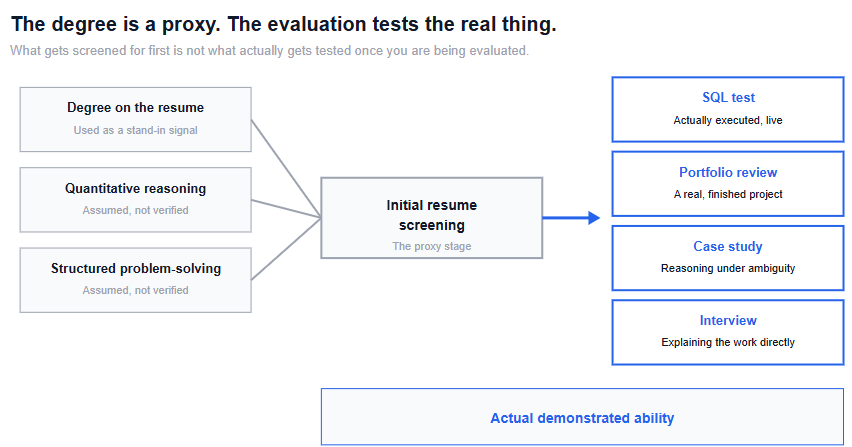
Strip away the assumption that a degree is required by rule, and what it typically signals to an employer is narrower than it looks: some baseline quantitative reasoning ability, exposure to structured problem-solving, and, for a company receiving hundreds of applications, a fast way to cut the pool down before anyone reads a resume closely.
It is worth being precise about how common a degree preference actually is, rather than guessing. The U.S. Department of Labor's O*NET database, which surveys employers directly about occupational requirements for Business Intelligence Analysts, a close match for the general data analyst role, found that respondents reported needing a bachelor's degree 68 percent of the time, a master's degree 23 percent of the time, and an associate's degree 5 percent of the time. Most employers do report wanting a degree of some kind. Notably, though, the same O*NET data lists the role's essential skills as reading comprehension, critical thinking, and mathematics, not a specific required software tool or a specific field of study, which is closer to what a portfolio project and live SQL fluency can actually demonstrate.
The moment a hiring process shifts from screening a pool down to evaluating one specific candidate, live SQL, a take-home task, a portfolio walkthrough, the degree proxy stops mattering and the real thing is what gets tested.
This is the part optimistic advice on this topic tends to skip, and it is worth stating plainly rather than glossing over.
Even when a company has publicly announced it dropped degree requirements, that announcement does not reliably translate into a different hiring outcome. A joint study from Harvard Business School's Project on Managing the Future of Work and the Burning Glass Institute, analysing job postings and actual hiring data from 2014 to 2023, found that meaningful hiring change occurred at a minority of firms that made this commitment; a substantial share of companies changed their job postings without a corresponding change in who actually got hired. A posting without a "degree required" line is not proof the screen behind it evaluates skills instead.
The mechanism behind this is not usually deliberate. It is often just how the filtering software works by default. Research on hiring technology has found that automated applicant tracking systems commonly rely on exact keyword and credential matches as negative filters, a category that includes degree requirements, which can screen out qualified candidates before a human ever sees the application, regardless of whether the underlying job genuinely needs that credential.
Put together, part of the real difficulty here is not about skill. It is about getting in front of a person who can actually evaluate it.
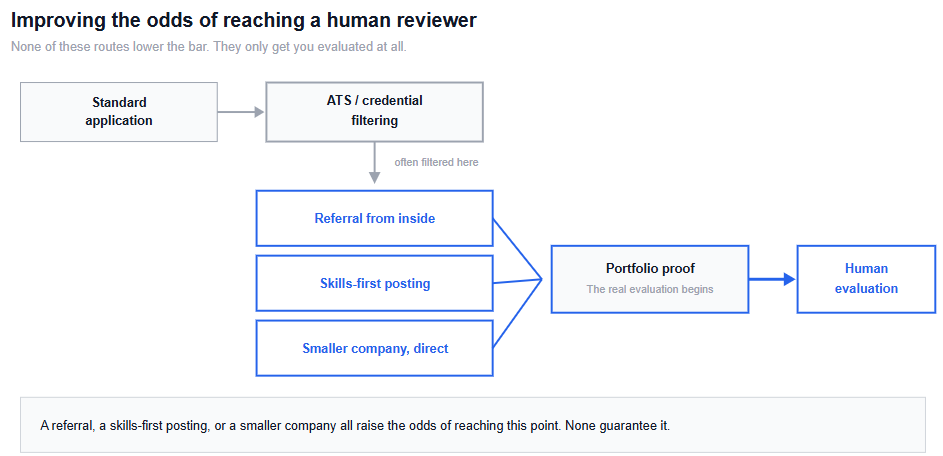
Once you are actually being evaluated, whether through a referral, a smaller company, or a role that tests skills directly, these are the things that carry real weight.
A finished, specific portfolio project. Not a tutorial you followed, a project with a real question, a dataset you had to clean yourself using standard tools such as pandas, whose own documentation covers the core data cleaning and manipulation operations most real projects require, and a conclusion you can defend under questioning. 20 data analytics project ideas for beginners is scoped specifically to produce this kind of evidence rather than a certificate of completion.
Demonstrated SQL fluency you can produce live, not just describe. Many Data Analyst interviews include a live SQL component, and this is where an unverified skills list gets tested directly. Real fluency means being comfortable with the core retrieval logic itself, selecting specific columns, filtering rows, and combining conditions, as MySQL's own reference documentation defines it, not just recognising the syntax when you see it. Practising against realistic, ambiguous business questions, not just syntax drills, is what actually prepares you for it; the 15 real-world business SQL problems set is built for exactly this.
Domain expertise from your current role, reframed as an asset. Priyanka's years in travel industry customer support are not a liability to explain away. For an analyst role at a travel or hospitality company specifically, that domain knowledge, understanding what actually drives a booking cancellation or a support escalation, is a real, uncommon advantage over a candidate with a technical degree and no exposure to the industry at all.
A course or certificate only if it forces you to produce real work. The credential itself carries limited independent weight; what matters is whether it produced a project you can talk through. Data analytics course versus self-learning covers this trade-off directly, and it is worth being clear-eyed about which one you actually need before spending money on it.
Being honest about the substitutes does not mean pretending the degree never matters at all.
Some government roles, public-sector postings, and specific regulated industries maintain hard degree requirements as formal policy, not just as a soft preference that skill can override. If a specific posting explicitly requires it as a condition of the role rather than a general preference, no portfolio changes that.
A technical degree can also become more relevant later, specifically if the career path eventually moves toward heavier statistical modelling or machine learning work, where deeper formal mathematical training genuinely does start to matter in a way it does not for most analyst-level work. That is a real consideration for the direction of a career five years out, not a reason to delay starting now.
Treating a certificate as the finish line. A completion certificate with no project behind it is a weaker signal than a single finished piece of real analysis, and it is worth spending the extra time on the project rather than collecting more certificates.
Being defensive about a non-technical background instead of reframing it. Domain expertise from a previous role is frequently a real asset for the right kind of analyst position, not something to apologise for in an interview.
Only applying through standard online postings. Given how often automated screening filters on degree requirements by default, relying entirely on that channel ignores the routes, referrals, smaller companies, skills-first postings, that are actually more likely to work.
Underestimating the live SQL component of the interview. A polished resume and portfolio get you to the interview. Being unable to write correct SQL under real-time pressure is where an otherwise strong candidate can still lose the role.
Assuming every employer's hiring process is the same. Some genuinely do filter hard on a degree as policy. Most do not, but confirming which kind of process you are actually up against changes where your effort should go.
Waiting until skills feel "ready" before applying anywhere. A finished project and working SQL fluency are a reasonable bar to clear before applying broadly; waiting for a feeling of complete readiness usually just delays a process that will teach you more once it starts.
In this scenario, Priyanka's first round of applications, mostly through large company career sites, produced almost no responses, which she initially read as a skills problem. It was not entirely one. A former colleague who had moved into a product role at a mid-sized travel technology company mentioned an open analyst position and offered to pass her resume along directly, and that single referral got her a first interview her online applications never had.
What actually carried the interview was specific. She had built a project analysing a public dataset of flight delay patterns, complete with a written explanation of her assumptions and a dashboard summarising the findings, and she could walk through every decision in it without hesitation. When the live SQL portion of the interview asked her to join and aggregate a multi-table dataset she had never seen before, her practice against realistic business-style problems, not just memorised syntax, is what got her through it cleanly.
Her interviewer also asked directly about her background in customer support, and rather than treating it as something to explain away, she connected it straight to the role: years of handling booking cancellations and complaints had given her a concrete, specific sense of which operational metrics actually mattered to the business, something a technical degree alone would not have provided. She got the offer. The degree question never came up again after that first conversation.
If you do not yet have a finished project to point to, 20 data analytics project ideas for beginners is the most useful place to start, since it is the single strongest substitute described in this article.
If SQL fluency is the specific gap standing between you and being interview-ready, work through realistic problems directly rather than only watching tutorials; the 15 real-world business SQL problems set is built for that.
And once you are applying, 50 data analyst interview questions is a fair way to test whether your preparation actually holds up under the kind of live questioning described in the example above.
Quiz
Question 1 of 15
FAQ
FREE COURSES
A complete, hands-on path from zero Git knowledge to running a full analytics workflow on GitHub. You'll learn how to track and undo changes safely, branch and merge without fear, collaborate with teammates through pull requests and code review, and handle the parts generic Git tutorials skip: version-controlling Jupyter notebooks and R projects, managing large data files with Git LFS, and structuring a repository so any analyst can pick it up. The course ends with two full portfolio projects: building a reviewed, documented analysis repository from scratch, and publishing an automated, GitHub Pages-hosted analytics portfolio powered by a scheduled GitHub Actions workflow.
A/B testing is one of the highest-leverage skills a data analyst can have: it's the difference between telling a company what happened and telling them what to do next. This course takes you from the foundations of experimentation through statistics, hypothesis testing, and experiment design, into the core statistical tests analysts use daily, honest result interpretation, and advanced pitfalls like Simpson's Paradox and multiple testing. You'll close with hands-on SQL and Python workflows and two full portfolio projects, so you finish with real work to show, not just notes.
Most of an analyst's time goes into cleaning, not analyzing, and this course treats that seriously. Five compact modules cover the full workflow: inspecting and typing a new file, handling missing data and duplicates, standardizing text and catching invalid values, merging and reshaping multiple sources, and finally building one reusable, validated cleaning pipeline. Every lesson runs on a realistically messy dataset with genuine data quality problems built in on purpose, so what you're fixing is real, not simulated. Closes with two portfolio projects: a multi-source merge and a full reshape-and-validate pipeline.