Data Analytics — Next cohort Starts Oct 24

Enroll Now

Time Series Forecasting with Python

Learn to forecast sales, product demand, and business metrics using Python. Start with time series fundamentals, data preparation, and simple baselines before progressing to exponential smoothing, ARIMA, SARIMA, and machine learning models. Evaluate forecasts using chronological backtesting, accuracy metrics, and prediction intervals. Learn to prevent data leakage, incorporate future business plans, forecast multiple products, and monitor performance.

author

Rutvik Acharya

Principal Data Scientist

Atlassian

Loading modules...

What You'll Learn

Prepare time series data by handling missing dates, outliers, and changing demand patterns.

Build and compare statistical and machine learning forecasts using Python.

Evaluate forecasts with chronological backtesting, accuracy metrics, and prediction intervals.

Complete two portfolio projects covering sales forecasting and product replenishment planning.

Who Should Attend

Data analysts who want to forecast sales, demand, and business metrics.

Python learners comfortable with basic syntax who want practical forecasting experience.

Business, operations, and supply chain professionals working with time-based data.

Aspiring data scientists who want forecasting projects for their portfolios.

CERTIFICATION

Certificate of Completion
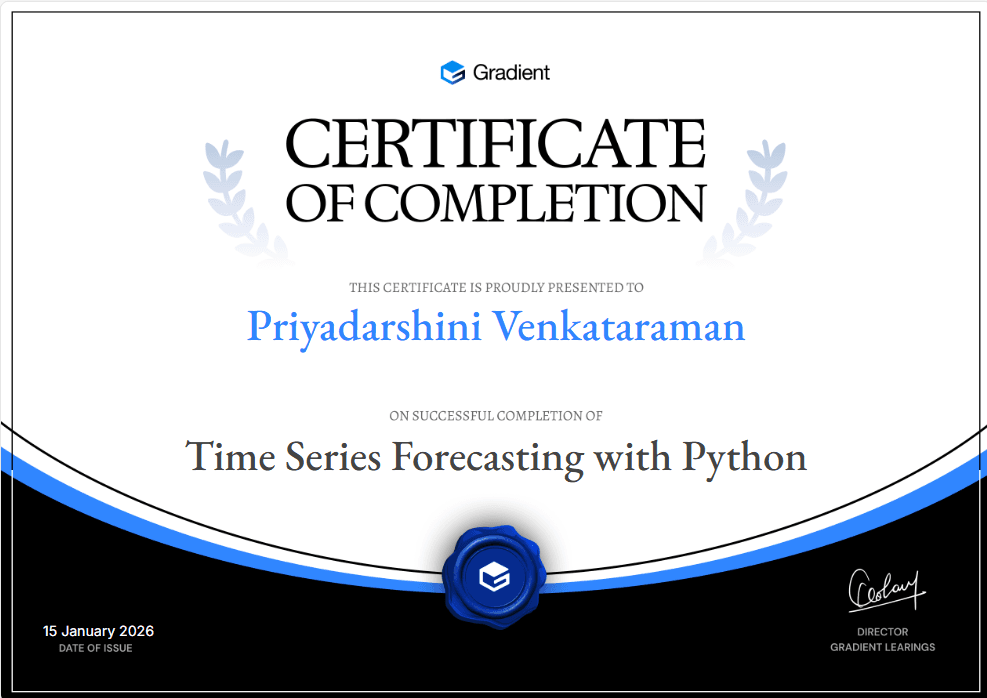
Certificate of Participation
Course
7 Modules
21 Hours
29 Lessons
29 Challenges
Language: English
PREMIUM

Explore Gradient Data Analytics Program and unlock a world of benefits

Structured Curriculum

Experience expert-led learning with our industry-proven curriculum

1:1 Mentorship Sessions

Learn from industry experts with our personalised 1:1 Mentorship

Career Support

We're dedicated to helping you achieve your career goals

FAQ

FREQUENTLY ASKED QUESTIONS

You will learn to prepare time series data, build forecasting baselines, apply statistical and machine learning models, evaluate forecast accuracy, and create reproducible forecasting workflows using Python.
No prior forecasting experience is required. The course begins with time series fundamentals. Basic Python knowledge is recommended for following the worked examples and exercises.
The worked examples use NumPy, pandas, Matplotlib, statsmodels, and scikit-learn for data preparation, visualization, statistical forecasting, and machine learning.
The course covers naive, seasonal naive, and moving average baselines, exponential smoothing, Holt’s method, Holt-Winters, ETS, ARIMA, SARIMA, SARIMAX, regression, and gradient boosting.
Yes. You will work with datetime indexes, frequency, resampling, missing dates, duplicate records, missing values, outliers, structural changes, transformations, and differencing.
You will use chronological splits and rolling backtests, calculate MAE, RMSE, WAPE, and MASE, and inspect forecast bias. The course also explains prediction intervals, coverage, and interval width.
Yes. You will learn to construct features and training labels using information available at each forecast origin, fit preprocessing within training periods, and evaluate recursive and direct multi-step forecasts.
Yes. The course covers local and global forecasting models, intermittent demand, and products with limited history. It also explains how to incorporate calendar features and origin-available price and promotion plans.
The course includes two complete projects: Store-Level Sales Forecasting and Product Demand Forecasting for Inventory Planning. Each provides a business problem, original synthetic datasets, specific questions, worked Python solutions, and interpretation of the results.
Yes. The modules include practice exercises with worked answers, runnable Python examples, and original visuals. The project materials also include datasets, scripts, and calculated result tables.
Scroll Up
GET FREE CAREER COUNSELING