Data Analytics — Next cohort Starts Oct 24

Enroll Now

SQL Query Optimization

Build practical SQL optimization skills across eight modules covering execution plans, indexing, joins, subqueries, aggregation, sorting, window functions, pagination, partitioning, and table maintenance. Work through consistent retail datasets, illustrated explanations, exercises, and complete SQL solutions. Learn to validate query results, compare performance fairly, and identify bottlenecks such as repeated processing, disk spills, and lock contention.

author

Rutvik Acharya

Principal Data Scientist

Atlassian

Loading modules...

What You'll Learn

Diagnose slow queries using execution plans, row estimates, timing, and buffer activity.

Optimize filters, indexes, joins, subqueries, aggregations, and window functions.

Improve pagination and large-table queries using keyset navigation, partitioning, and summaries.

Validate query correctness, compare performance fairly, and investigate lock contention.

Who Should Attend

Data analysts who want to improve the performance of SQL reports and dashboards.

Analytics and data engineers working with joins, transformations, and large tables.

Developers building database-backed search, reporting, and pagination features.

SQL learners comfortable with filtering, joins, and aggregation who want practical optimization experience.

CERTIFICATION

Certificate of Completion
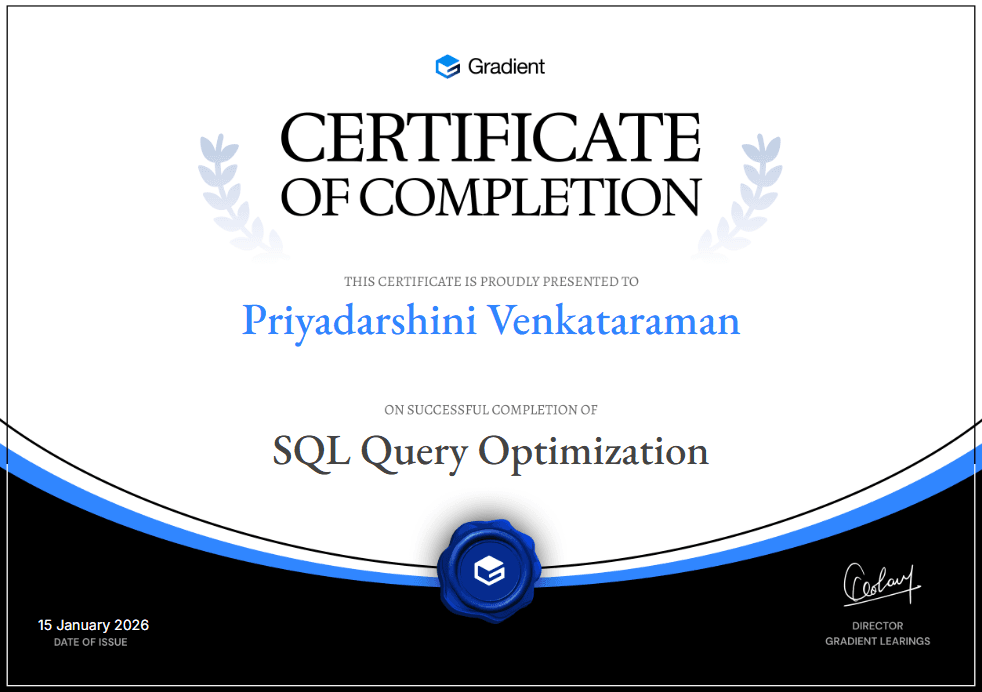
Certificate of Participation
Course
8 Modules
8 Hours
28 Lessons
28 Challenges
Language: English
PREMIUM

Explore Gradient Data Analytics Program and unlock a world of benefits

Structured Curriculum

Experience expert-led learning with our industry-proven curriculum

1:1 Mentorship Sessions

Learn from industry experts with our personalised 1:1 Mentorship

Career Support

We're dedicated to helping you achieve your career goals

FAQ

FREQUENTLY ASKED QUESTIONS

The course is designed for data analysts, analytics engineers, data engineers, developers, and SQL learners who want to diagnose slow queries and improve database performance.
You should understand SELECT statements, WHERE filters, basic joins, and aggregation with functions such as COUNT and SUM. Prior experience with execution plans is not required.
The course uses PostgreSQL for practical examples, execution-plan analysis, indexing experiments, and projects. You will need a PostgreSQL practice database and a SQL editor to run the examples.
The eight modules cover query performance foundations, execution plans, filtering and indexing, joins and subqueries, aggregation and window functions, large-table optimization, a practical optimization workflow, and portfolio projects.
Yes. You will learn to interpret EXPLAIN and EXPLAIN ANALYZE output, compare estimated and actual row counts, and investigate timing, loops, buffer activity, and expensive operations.
Yes. The course includes exercises with worked solutions, SQL setup scripts, and consistent retail examples from the fictional company Kestrel Outfitters. Small datasets support manual checks, while generated datasets support larger query experiments.
You will explore single-column, composite, expression, covering, and partial indexes. You will also learn to write index-friendly filters, investigate unused indexes, and assess storage and maintenance tradeoffs.
Yes. The course includes two end-to-end projects: optimizing a retail sales dashboard and improving order search and customer history. Both include business requirements, reproducible data, worked SQL solutions, and validation checks.
Yes. You will study partitioning, materialized views, summary tables, memory limits, disk spills, statistics, and vacuuming. You will also learn to identify lock waits and blocking transactions.
You will compare original and rewritten results, test boundary cases, capture execution plans, and repeat measurements under comparable conditions. The course emphasizes preserving correctness and measuring performance in your own PostgreSQL environment.
Scroll Up
GET FREE CAREER COUNSELING