Marketing Analytics for Beginners

A complete, hands-on introduction to marketing analytics for anyone starting out in the field. Covers the full journey from foundational concepts to job-ready skills: core marketing metrics (CTR, CAC, LTV, ROAS), customer segmentation and cohort analysis, A/B testing and experimentation, multi-touch attribution, SQL and spreadsheet analysis, dashboard design, and forecasting. Every lesson uses a consistent running case study - Northloom, a direct-to-consumer outdoor apparel brand - so concepts build on each other with realistic, connected examples rather than one-off exercises. Includes original diagrams for every lesson and two full end-to-end portfolio projects with real downloadable datasets and worked solutions: an e-commerce campaign performance and segmentation analysis, and a multi-channel attribution and budget reallocation project.

author

Rutvik Acharya

Principal Data Scientist

Atlassian

Loading modules...

What You'll Learn

Calculate and interpret core marketing metrics like CTR, CAC, LTV, ROAS, and churn rate

Segment customers and analyze cohort retention using RFM and other frameworks

Design valid A/B tests and correctly interpret statistical significance

Forecast trends and build a simple churn-prediction framework

Who Should Attend

Aspiring marketing analysts with little to no prior analytics experience

Marketers who want to back their decisions with data instead of guesswork

Career changers moving into marketing, growth, or data-adjacent roles

Small business owners and founders who want to understand their own marketing numbers

CERTIFICATION

Certificate of Completion
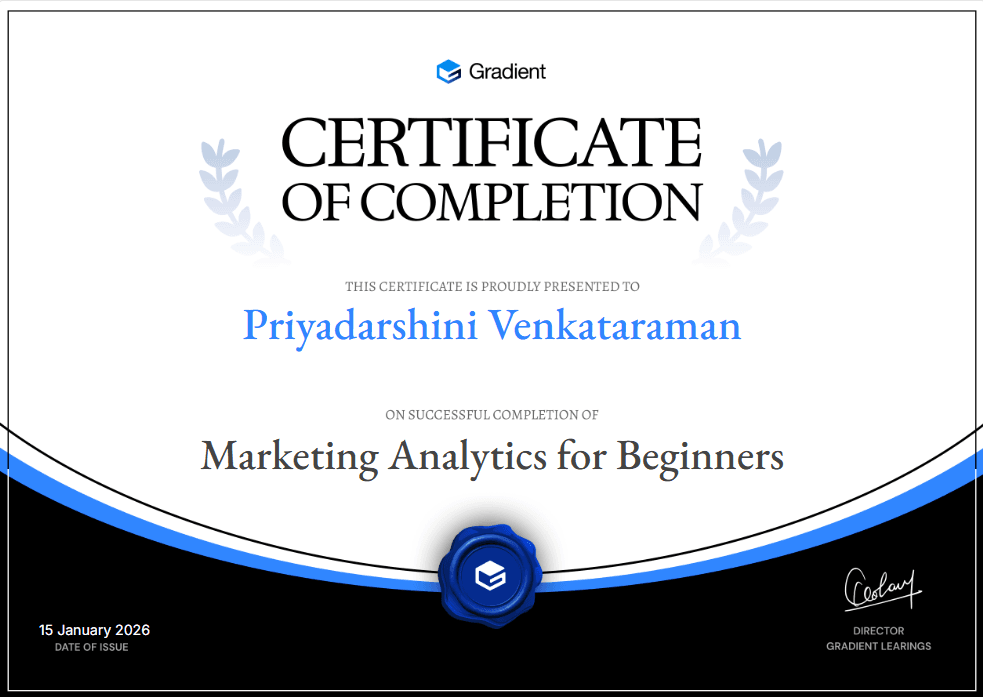
Certificate of Participation
Course
10 Modules
14 Hours 30 Minutes
47 Lessons
47 Challenges
Language: English

FAQ

FREQUENTLY ASKED QUESTIONS

No. The course is built for beginners and starts from first principles, using a single running case study, an outdoor apparel brand called Northloom, so every lesson builds on the last with realistic, connected examples rather than one-off exercises.
You will be able to calculate and interpret core marketing metrics like CTR, CAC, LTV, and ROAS, segment customers and analyze cohort retention, design valid A or B tests and interpret statistical significance, apply multiple attribution models to real customer journeys, query and clean data using SQL and spreadsheets, build effective dashboards, and put together a basic forecasting or churn prediction framework.
The course has nine core modules that take you from foundational concepts through to job-ready analytical skills, followed by two full end-to-end portfolio projects. Each module covers a focused topic in marketing analytics, and the two capstone projects apply everything from the earlier modules to complete, realistic business problems.
Yes. Both portfolio projects come with real downloadable datasets and a complete worked solution. The first project covers e-commerce campaign performance and customer segmentation, and the second covers multi-channel attribution and marketing budget reallocation.
No prior SQL or programming experience is required. The course includes a dedicated module that introduces spreadsheets and SQL from the basics, covering pivot tables, key formulas, and how to write and read a SQL query, before moving into more advanced querying techniques like joins and aggregations.
Yes. There is a full module on campaign performance analysis and experimentation, covering how to evaluate channels fairly, how to design a valid A or B test, how to interpret statistical significance in plain language, and common pitfalls like peeking at results early or mistaking seasonal patterns for real effects.
The course dedicates a full module to attribution, covering why it is a genuinely hard problem, single-touch models like first-touch and last-touch, multi-touch models like linear, time-decay, and U-shaped, and how to choose the right model for a given business. It also covers the limitations of click-based attribution and introduces media mix modeling as a complementary approach.
Both. Beyond analysis, the course includes a module specifically on communicating results, covering the principles of effective dashboard design, how to choose the right chart for a given question, how to structure recurring marketing reports, and how to tell a clear story with data rather than presenting a disconnected set of charts.
Yes. The final core module introduces marketing forecasting, trend and seasonality analysis, the basics of marketing mix modeling, and a beginner-friendly framework for predicting customer churn. It closes by placing these skills on a spectrum between core marketing analytics and more advanced data science work, so you understand where this course's skills fit and what a natural next step would look like.
No. While it is well suited to anyone pursuing a marketing analyst or growth analyst role, the material is equally useful for marketers who want to back their decisions with data instead of guesswork, career changers moving into data-adjacent roles, and small business owners or founders who want to understand their own marketing numbers.
Scroll Up
GET FREE CAREER COUNSELING