Machine Learning for Data Analysts

Machine Learning for Data Analysts is a practical, hands-on course built for analysts who already know SQL, Excel, or BI tools and want to add predictive modeling to their skill set. Instead of abstract theory, every concept is taught through a single running business scenario, an online retailer named NorthPeak Outfitters, so techniques build on each other from lesson to lesson instead of feeling disconnected.

author

Rutvik Acharya

Principal Data Scientist

Atlassian

Loading modules...

What You'll Learn

Prepare real-world data: handle missing values, outliers, and encoding before modeling

Build and evaluate regression and classification models with scikit-learn

Discover hidden customer segments using clustering and PCA

Tune, compare, and explain models using cross-validation and SHAP

Who Should Attend

Data analysts who know SQL or Excel and want to add predictive modeling

BI professionals looking to move beyond dashboards into forecasting

Junior data scientists wanting a practical, business-first foundation

Anyone who has taken a theory-heavy ML course and needs the applied version

CERTIFICATION

Certificate of Completion
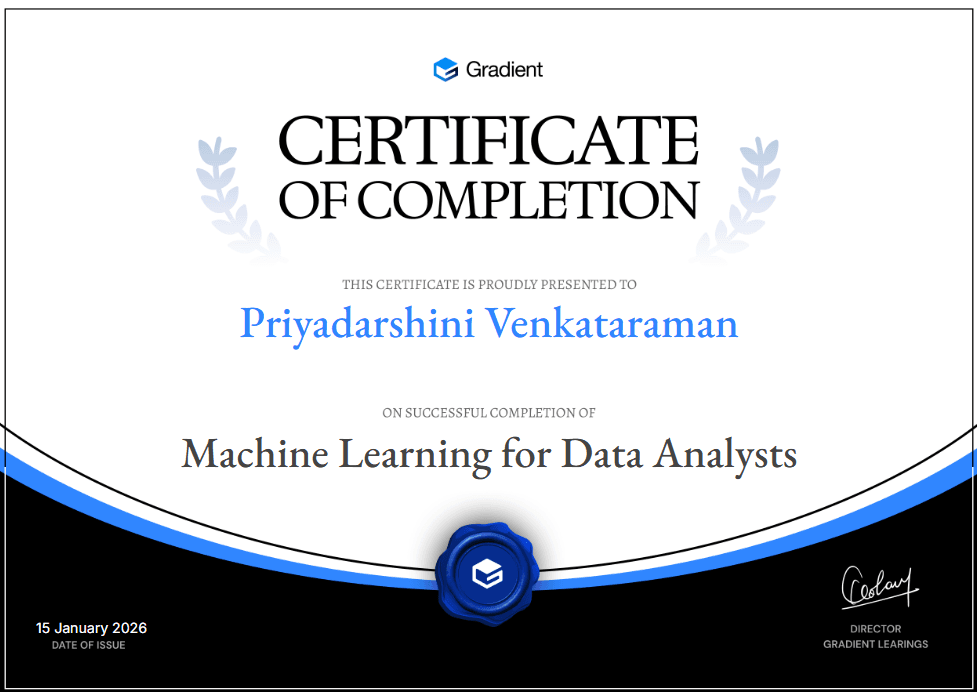
Certificate of Participation
Course
8 Modules
26 Hours
43 Lessons
43 Challenges
Language: English

FAQ

FREQUENTLY ASKED QUESTIONS

You should be comfortable with SQL, Excel, or basic Python from prior data analysis work, since the course builds on those skills rather than teaching them from scratch. Module 1 does include a section on setting up Python, Jupyter, pandas, and scikit-learn, so you do not need prior machine learning experience, just general data analysis fundamentals.
No advanced math is required. Module 1 includes a focused statistics refresher covering only what an analyst actually needs for machine learning, such as distributions, correlation, and the intuition behind hypothesis testing. There is no calculus or linear algebra prerequisite.
The course uses Python together with Jupyter Notebook, pandas, and scikit-learn, the standard toolkit for applied machine learning. Later modules also introduce XGBoost and LightGBM for gradient boosting, and the SHAP library for model interpretability.
This course is built specifically for data analysts who want to add practical machine learning to their existing skill set, not for those pursuing a deep, research-oriented data science track. It focuses on applied, business-relevant techniques rather than theoretical derivations or advanced mathematics.
Yes. Every module builds around a single consistent scenario, an online retailer called NorthPeak Outfitters, so techniques carry over and build on each other from lesson to lesson instead of using disconnected, unrelated examples.
You will complete three full portfolio projects with worked solutions: a customer churn prediction model, a retail demand forecasting model, and a customer segmentation project for targeted marketing. Each project includes a business problem, a dataset, specific questions to answer, and a complete solution you can adapt for your own portfolio.
The course is organized into eight modules, moving from foundational concepts and data preparation, through regression, classification, and unsupervised learning, into model evaluation, communicating results, and finally the portfolio projects. Each module includes multiple lessons with practical examples, exercises, and interview-style questions.
The full course runs approximately 30 hours across all eight modules, though pacing depends on how much time you spend on the practice exercises and portfolio projects. Each module lists its own estimated duration so you can plan your progress.
No. This course focuses on classical, widely used machine learning techniques such as regression, classification, clustering, and gradient boosting, which cover the vast majority of real business analytics problems. Deep learning and NLP are not included in this curriculum.
Yes, a certificate of completion is provided once you finish the course.
Scroll Up
GET FREE CAREER COUNSELING