Data Analytics — Next cohort Starts Oct 24

Enroll Now

DBT Fundamentals for Data Analysts

Learn how to turn standalone SQL queries into reusable, tested, and documented analytical models with dbt. Start with project setup, sources, and model dependencies. Progress through analytical table design, data validation, Jinja, macros, incremental models, snapshots, and seeds. Learn to document your work, review changes with Git, and troubleshoot transformation jobs.

author

Rutvik Acharya

Principal Data Scientist

Atlassian

Loading modules...

What You'll Learn

Build SQL models using sources, ref(), and staging, intermediate, and mart layers.

Design reliable analytical tables with clear grain, keys, and safe joins.

Validate data using built-in tests, custom SQL assertions, source freshness, and unit tests.

Document dependencies, review changes with Git, and troubleshoot dbt jobs.

Who Should Attend

Data analysts with basic SQL knowledge who want to build reusable reporting models.

BI analysts who need consistent, tested datasets for dashboards.

SQL users moving from standalone queries to structured analytics workflows.

Aspiring analytics engineers seeking practical experience with dbt.

CERTIFICATION

Certificate of Completion
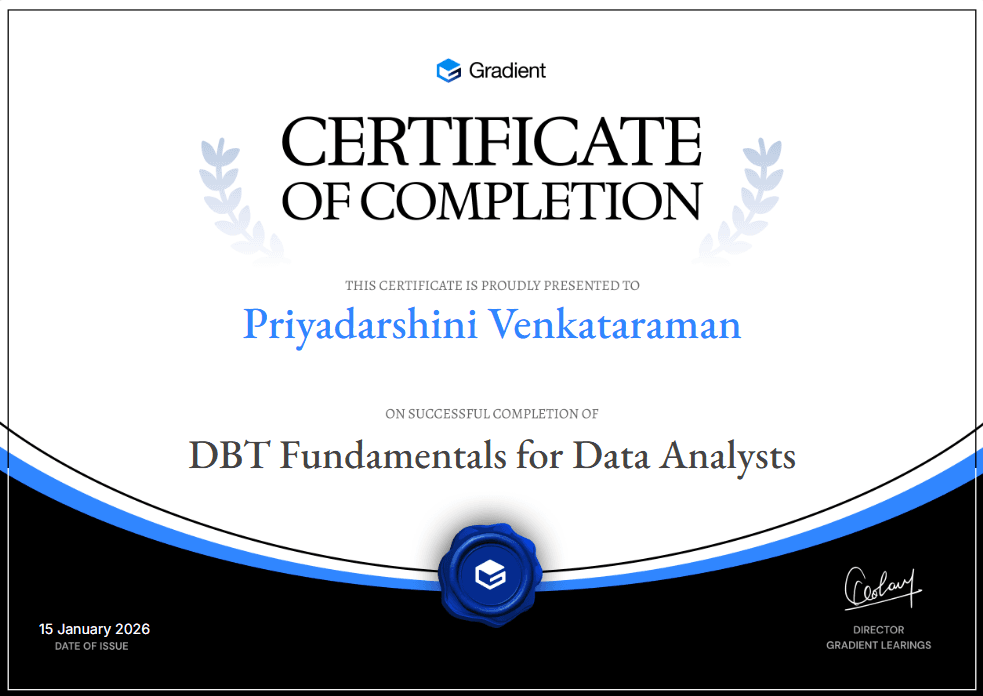
Certificate of Participation
Course
8 Modules
25 Hours
32 Lessons
32 Challenges
Language: English
PREMIUM

Explore Gradient Data Analytics Program and unlock a world of benefits

Structured Curriculum

Experience expert-led learning with our industry-proven curriculum

1:1 Mentorship Sessions

Learn from industry experts with our personalised 1:1 Mentorship

Career Support

We're dedicated to helping you achieve your career goals

FAQ

FREQUENTLY ASKED QUESTIONS

This course is designed for data analysts, BI analysts, SQL users, and aspiring analytics engineers who want to build reliable SQL transformation workflows.
No prior dbt experience is required. The course begins with dbt fundamentals, project setup, and your first SQL model.
Basic SQL knowledge is recommended, including SELECT, WHERE, GROUP BY, and joins. Later modules build on these concepts.
No. The practice environment uses dbt Core and a local DuckDB database, so you can complete the exercises without a paid warehouse account.
The course covers SQL models, sources, dependencies, analytical table design, data testing, Jinja, macros, packages, incremental models, snapshots, seeds, documentation, Git collaboration, and job troubleshooting.
Yes. You will use built-in data tests, custom SQL assertions, source freshness checks, and unit tests. You will also investigate failures and reconcile model outputs against expected results.
Yes. You will practise incremental processing, updates, late-arriving records, and full refreshes. You will also use snapshots to capture observed historical changes.
Yes. The course includes original datasets, practical exercises, worked answers, SQL examples, and companion project files. A consistent fictional retail business connects the examples.
You will complete Retail Sales Analytics and Customer Retention Analytics. Both include business problems, datasets, analytical questions, complete worked solutions, and validation checks.
The course contains eight modules, progressing from setup and SQL modelling to validation, reusable SQL, changing data, and project delivery. The final module contains two complete portfolio projects.
Scroll Up
GET FREE CAREER COUNSELING