Data Analytics — Next cohort Starts Oct 24

Enroll Now

Data Governance & Privacy for Data Analysts

Learn to classify sensitive information, document data ownership, create data dictionaries, trace lineage, and apply appropriate access controls. Explore privacy principles, essential regulatory concepts, masking, tokenisation, aggregation, retention, and incident response. Apply your learning to realistic customer analytics and support reporting projects with synthetic datasets, worked solutions, and runnable Python and SQL examples. Designed for aspiring and working data analysts who want to handle data responsibly and produce trustworthy analysis.

author

Rutvik Acharya

Principal Data Scientist

Atlassian

Loading modules...

What You'll Learn

Classify personal and confidential information, assign data ownership, and create inventories, dictionaries, and business glossaries.

Understand essential privacy principles and regulatory concepts, and apply appropriate access, sharing, and retention controls.

Use masking, tokenisation, aggregation, and disclosure checks to reduce exposure while preserving useful analysis.

Build governed customer analytics and support reporting projects with documented lineage, quality checks, and worked Python and SQL solutions.

Who Should Attend

Aspiring data analysts who want to learn responsible data handling alongside analytical skills.

Working data and business analysts who handle customer, employee, financial, or operational information.

BI and reporting professionals who need clearer definitions, traceable metrics, and appropriate dashboard permissions.

Students and career switchers who want practical governance and privacy projects for their analytics portfolios.

CERTIFICATION

Certificate of Completion
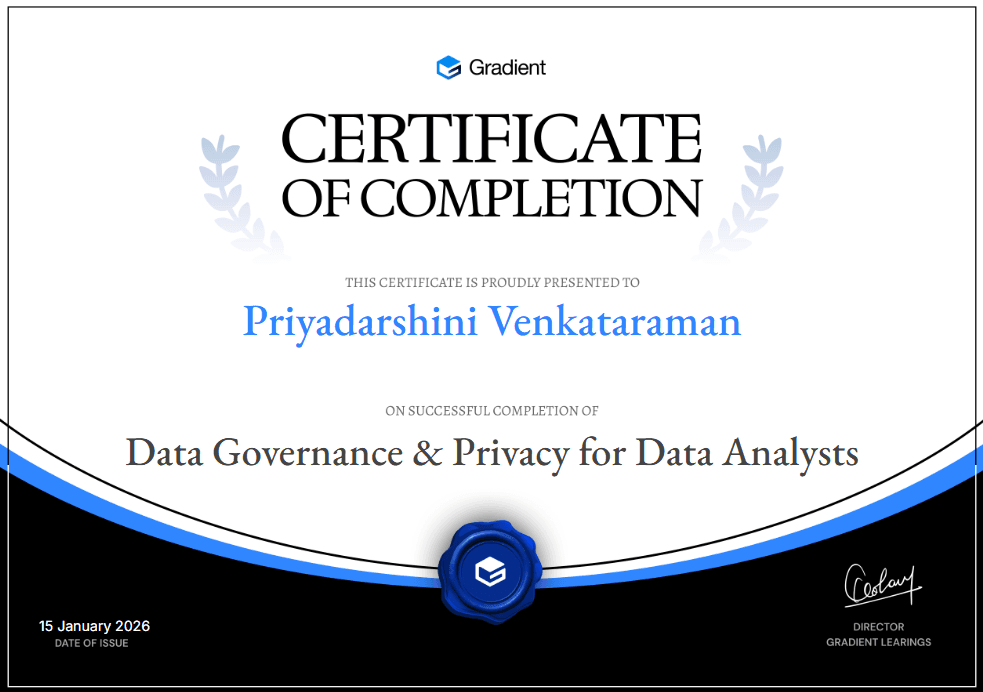
Certificate of Participation
Course
8 Modules
10 Hours
39 Lessons
39 Challenges
Language: English
PREMIUM

Explore Gradient Data Analytics Program and unlock a world of benefits

Structured Curriculum

Experience expert-led learning with our industry-proven curriculum

1:1 Mentorship Sessions

Learn from industry experts with our personalised 1:1 Mentorship

Career Support

We're dedicated to helping you achieve your career goals

FAQ

FREQUENTLY ASKED QUESTIONS

The course covers data governance foundations, data classification, privacy principles, access control, privacy techniques, metadata, lineage, data quality, retention, and incident response. It concludes with two portfolio projects.
It is designed for aspiring and working data analysts, business analysts, BI professionals, students, and career switchers who want to handle data responsibly and produce trustworthy analysis.
No prior governance or privacy experience is required. The course starts with foundational concepts. Basic familiarity with spreadsheets and business reports will help.
Coding is not required to follow the core explanations and worked solutions. Python and SQL examples support the practical work, and the portfolio projects include an optional runnable solution.
The course contains eight modules and 39 lessons, progressing from governance fundamentals to practical privacy controls and end-to-end portfolio projects. The lessons include original diagrams and practical exercises.
The course introduces India's DPDP framework, GDPR, and CCPA/CPRA. It explains applicability and commencement considerations and shows when analysts should involve designated privacy or legal reviewers.
You will explore masking, redaction, tokenisation, pseudonymisation, aggregation, and small-group protection. The course also explains re-identification risks and why removing names or meeting a numerical threshold does not automatically establish anonymity.
The first project builds a governed customer analytics dataset with documented definitions, quality checks, access findings, and a city-level reporting candidate. The second reviews a customer support dashboard, covering data minimisation, reporting groups, permissions, retention, and incident handling.
No real customer data is needed. The projects provide synthetic datasets and a Python solution that uses standard-library tools and an in-memory SQLite database. Running the supplied solution does not require a database server, cloud account, or internet connection.
Yes. Both portfolio projects include business problems, source records, setup instructions, worked calculations, code, expected results, and governance documentation. They distinguish executable checks from controls that require implementation and verification in a real environment.
Scroll Up
GET FREE CAREER COUNSELING