AI for Data Analysts

This course teaches you how to use AI as a reliable force multiplier for data analytics from AI-assisted SQL, Python, EDA, and visualization to automated reporting and analyst agents. Learn a five-layer verification framework to validate AI-generated insights before they influence decisions. Explore applied ML, AI governance, ethics, and six portfolio projects from beginner to advanced. Built for analysts who know the basics and want to work faster without sacrificing accuracy or trust.

author

Rutvik Acharya

Principal Data Scientist

Atlassian

Loading modules...

What You'll Learn

Use AI to draft and debug SQL and Python faster and catch the moment it's confidently wrong

Apply the Analyst AI Verification Framework to check data, logic, calculations, interpretations, and recommendations

Work with AI features inside Excel, Power BI, Tableau, and Snowflake and evaluate the next tool that adds one

Build AI-assisted pipelines, structured data extraction, and simple multi-step agents in Python

Who Should Attend

Data analysts who already know SQL/Excel basics and want to work faster with AI, without losing rigor

BI or reporting analysts whose tools have added AI features they haven't fully learned to use or trust

Analysts who've used ChatGPT or Copilot casually and want a reliable, repeatable process instead

Anyone moving into an "AI-augmented analyst" role who wants a framework for what to verify, not just what to prompt

CERTIFICATION

Certificate of Completion
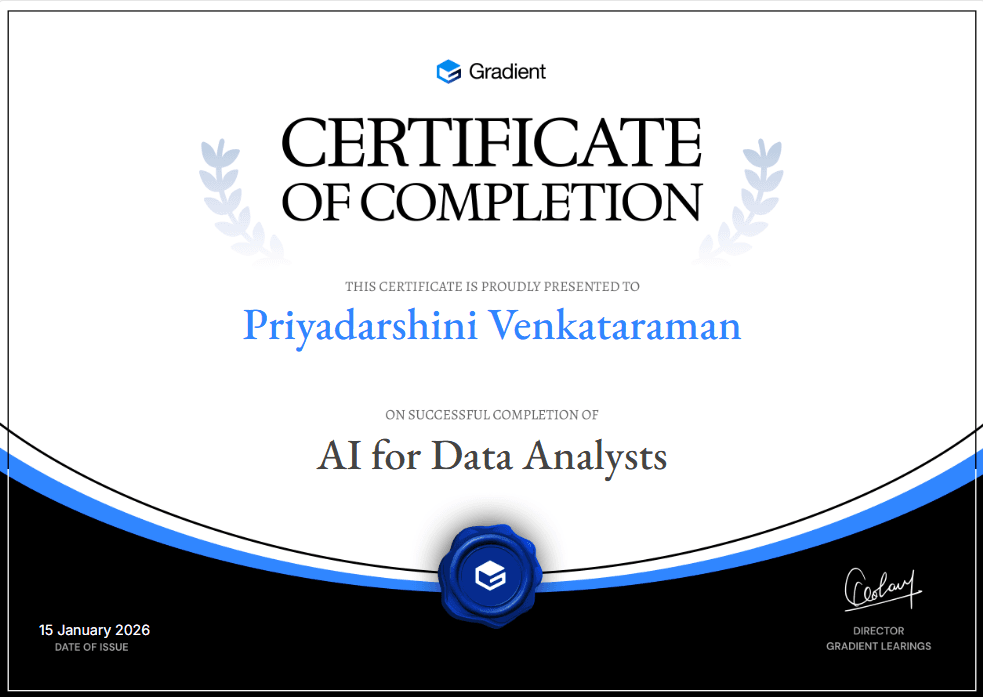
Certificate of Participation
Course
9 Modules
13 Hour 30 Minutes
46 Lessons
46 Challenges
Language: English

FAQ

FREQUENTLY ASKED QUESTIONS

Yes, this course assumes you already have basic data analyst skills such as SQL, Excel, and basic visualization. It is designed as a bridge course that layers AI capabilities on top of existing analytics skills rather than teaching analytics from scratch.
No. This course teaches you to be an informed consumer of machine learning outputs such as segmentation, forecasting, and anomaly detection, not to build or train models yourself. Module 1 draws a clear line between what a data analyst using AI needs to know and what a data scientist or ML engineer builds.
The course includes 9 core modules and 46 lessons, covering AI foundations, the full AI-assisted analytical workflow, a signature five-layer verification framework, AI features in everyday analyst tools, applied machine learning, Python and AI APIs, data storytelling, automation and AI agents, and responsible AI use.
No. The course teaches AI capabilities first and uses current tools such as Copilot in Excel, Power BI Copilot, Tableau Agent, and Snowflake Cortex Analyst only as examples of those capabilities. This approach is meant to keep the skills you learn useful even as specific products change.
The course is built around the Analyst AI Verification Framework, a five-layer method for checking AI-assisted work across data, logic, calculation, interpretation, and recommendation. This framework is applied consistently across every module, from SQL and Python work to visualization, automation, and AI agents, rather than treating AI verification as a one-off topic.
Some modules include SQL and Python, including a dedicated module on calling AI APIs directly from Python and building simple AI-assisted pipelines and agents. You do not need prior coding expertise beyond basic analyst-level SQL, but a willingness to work with Python code is expected in the later modules.
Scroll Up
GET FREE CAREER COUNSELING